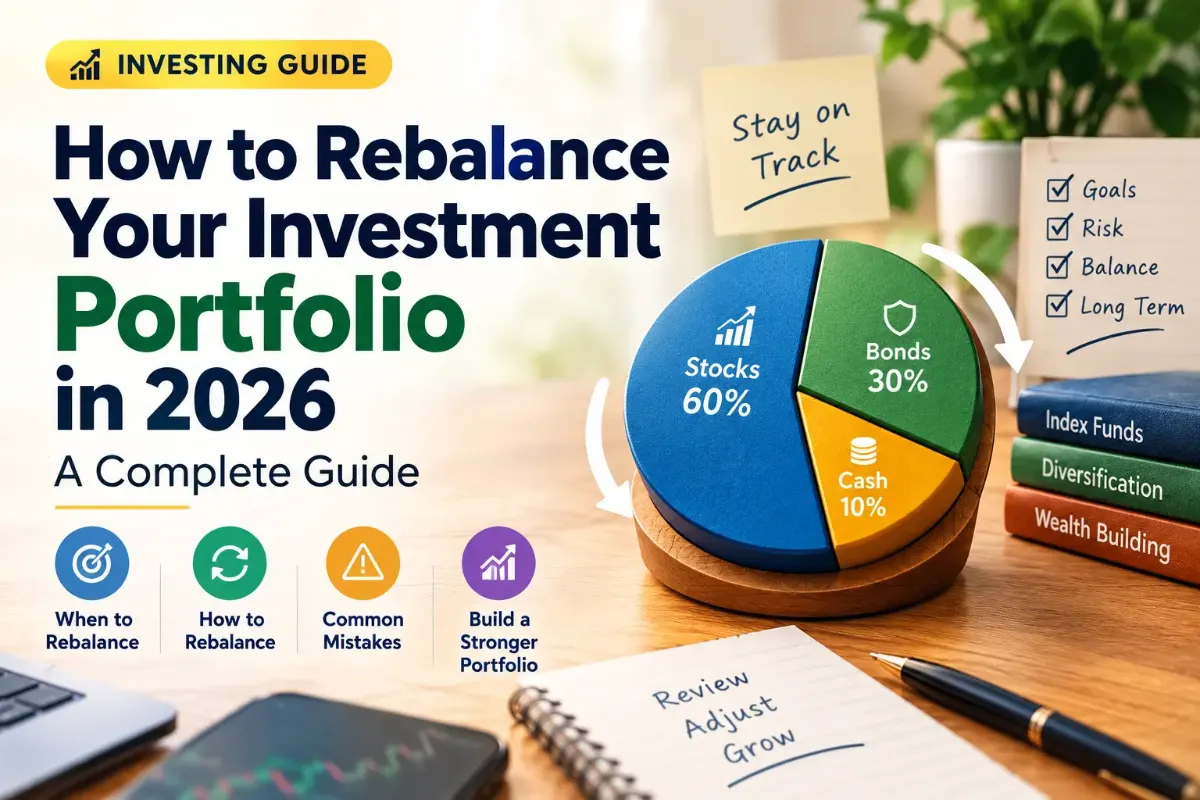
# How to Rebalance Your Investment Portfolio in 2026: A Complete Guide
Building an investment portfolio is only the beginning of a long-term investing strategy.
Over time, different investments grow at different rates. A portfolio that originally matched your preferred risk level can gradually become more aggressive—or more conservative—without you intentionally changing it.
This is where portfolio rebalancing comes in.
Rebalancing means adjusting your investments to bring your portfolio closer to its intended asset allocation. Instead of allowing market performance to determine your portfolio structure, you periodically review your holdings and make adjustments when necessary.
For long-term investors, rebalancing can be an important part of maintaining a disciplined investment strategy.
In this guide, we'll explain how portfolio rebalancing works, when you may want to consider it, different ways to rebalance, and the mistakes investors should avoid in 2026.
What Is Portfolio Rebalancing?
Portfolio rebalancing is the process of bringing your investment portfolio back toward its intended asset allocation.
Your asset allocation is the way your money is divided among different investment categories, such as stocks, bonds, cash, and other assets.
For example, imagine an investor creates a portfolio with:
- 70% stocks
- 20% bonds
- 10% cash
If stocks perform strongly over several years, the portfolio might eventually become:
- 82% stocks
- 12% bonds
- 6% cash
The investor did not necessarily choose to take on this additional stock exposure. It happened because the different parts of the portfolio produced different returns.
Rebalancing attempts to bring the portfolio closer to the investor's intended allocation.
Why Does a Portfolio Need Rebalancing?
Markets rarely move in perfect balance.
One asset class may rise substantially while another remains flat or declines. Over time, these differences can change the structure of your portfolio.
That can affect the amount of risk you're taking.
Suppose you originally selected a 60% stock and 40% bond portfolio because that combination matched your goals and risk tolerance.
After a strong stock-market period, stocks grow until they represent 75% of the portfolio.
You now have considerably more exposure to stocks than you originally planned.
The portfolio may still be performing well, but its risk characteristics have changed.
Rebalancing gives you an opportunity to restore your intended allocation.
A Simple Portfolio Rebalancing Example
Consider a portfolio worth $100,000.
The original target allocation is:
| Asset | Target | Original Value |
|---|---|---|
| Stocks | 60% | $60,000 |
| Bonds | 30% | $30,000 |
| Cash | 10% | $10,000 |
| Total | 100% | $100,000 |
After a period of different market performance, the portfolio becomes:
| Asset | Current Value |
|---|---|
| Stocks | $72,000 |
| Bonds | $23,000 |
| Cash | $5,000 |
| Total | $100,000 |
The portfolio is now:
- 72% stocks
- 23% bonds
- 5% cash
The investor originally wanted 60% stocks, 30% bonds, and 10% cash.
The portfolio therefore needs an adjustment if the investor still believes the original allocation is appropriate.
Portfolio Rebalancing vs. Changing Your Investment Strategy
These two concepts are different.
Rebalancing means returning to an existing investment plan.
Changing your investment strategy means deciding that the original plan is no longer appropriate.
For example, an investor might originally choose:
> 70% stocks / 30% bonds
If that investor later decides that their financial situation, time horizon, or risk tolerance has changed and chooses:
> 60% stocks / 40% bonds
that is an allocation change rather than simply rebalancing.
This distinction is important because investors should not automatically change their long-term strategy simply because one part of the market has recently performed well.
When Should You Rebalance Your Portfolio?
There is no single schedule that works for every investor.
Two common approaches are calendar-based rebalancing and threshold-based rebalancing.
Calendar-Based Rebalancing
With a calendar-based approach, you review your portfolio at predetermined intervals.
For example:
- Every six months
- Once a year
- At another predetermined interval
The important part is having a consistent process rather than constantly reacting to market movements.
Threshold-Based Rebalancing
With a threshold approach, you rebalance when an asset class moves sufficiently far away from its target.
For example, suppose your target allocation for stocks is 60%.
You might establish a rule that you will review the portfolio if stocks move more than 5 percentage points away from that target.
If stocks reach 66% or fall to 54%, you may review whether rebalancing is appropriate.
The exact threshold should depend on your own investment strategy rather than being copied blindly from another investor.
How Often Should You Rebalance?
More frequent rebalancing is not necessarily better.
Constantly changing your portfolio can increase trading activity, costs, taxes, and emotional decision-making.
A disciplined investor may instead review the portfolio periodically and rebalance only when there is a meaningful deviation from the intended allocation.
The goal is not to make every market movement trigger a transaction.
The goal is to maintain a portfolio that remains consistent with your long-term plan.
Three Ways to Rebalance a Portfolio
There are several ways investors can bring a portfolio back toward its target allocation.
1. Sell Overweight Investments
An investor can sell part of an asset category that has become too large and use the proceeds to purchase an underweight category.
For example, if stocks have grown from a 60% target to 70%, an investor could sell some stock exposure and redirect the proceeds elsewhere.
However, selling investments may have tax consequences or transaction costs depending on the account and jurisdiction.
2. Buy the Underweight Asset
Instead of selling the overweight investment, an investor can direct new money toward the underweight asset.
For example, if stocks have become overweight while bonds are below their target allocation, new contributions could be directed toward bonds until the portfolio moves closer to its target.
This can be particularly useful for investors who are regularly adding money to their portfolios.
3. Adjust New Contributions
Investors who make regular contributions can sometimes rebalance simply by changing where new money goes.
Suppose your portfolio contains:
- 70% stocks
- 20% bonds
- 10% cash
but your target is:
- 60% stocks
- 30% bonds
- 10% cash
Instead of immediately selling stocks, you could direct future contributions primarily toward bonds.
This can gradually move the portfolio closer to its intended allocation.
Rebalancing and Diversification
Rebalancing works closely with diversification, but they are not the same thing.
Diversification is about spreading investments across different assets, companies, sectors, or markets.
Rebalancing is about maintaining the intended proportions of those investments over time.
For example, owning several different funds does not automatically mean your portfolio is properly diversified.
You may have multiple funds that hold many of the same companies.
Before rebalancing, look beyond the number of investments you own and understand what those investments actually contain.
If you're building a portfolio from index funds, our guide to the best index funds to invest in 2026 can help you explore the role of index-based investing.
Rebalancing and Risk
One of the main reasons investors rebalance is to keep portfolio risk closer to the level they originally intended.
Imagine an investor chooses a 50/50 stock-and-bond portfolio.
If stocks significantly outperform bonds, the portfolio could eventually become 70/30.
The investor is now more exposed to stock-market fluctuations than when the original strategy was created.
Rebalancing can restore the portfolio toward its original structure.
However, risk tolerance is personal.
An allocation that is appropriate for one investor may be inappropriate for another.
Your investment time horizon, financial goals, income, savings, and willingness and ability to tolerate losses all matter.
Should You Rebalance During a Market Crash?
A major market decline can make rebalancing emotionally difficult.
Investors may be tempted to sell assets that have fallen sharply or abandon their investment strategy altogether.
However, rebalancing should generally be based on a predetermined investment plan rather than fear or excitement.
If your original asset allocation remains appropriate, a market decline may cause some assets to become underweight while others become overweight.
Rebalancing can then help restore the portfolio toward its target allocation.
This does not mean investors should automatically buy every declining asset.
The investment itself still needs to be appropriate for the investor's strategy.
For investors concerned about market downturns, our recession-proof investment portfolio guide provides a broader discussion of portfolio resilience.
Rebalancing in a Bull Market
Strong markets can create a different psychological problem.
When an investment has produced exceptional returns, investors may become reluctant to reduce their exposure.
But if that investment now represents a much larger percentage of the portfolio than intended, the portfolio may no longer match the original risk profile.
Rebalancing forces investors to evaluate the portfolio based on their plan rather than simply chasing recent performance.
Common Portfolio Rebalancing Mistakes
Mistake 1: Rebalancing Too Frequently
Checking your portfolio every day and making constant adjustments can turn long-term investing into short-term trading.
A disciplined strategy usually requires patience.
Mistake 2: Ignoring Taxes and Fees
Selling investments may create taxable gains in some accounts and jurisdictions.
Transaction costs may also apply.
Before making changes, investors should understand the consequences.
Mistake 3: Chasing Recent Winners
An asset that has performed extremely well may continue to perform well—or it may not.
Increasing an allocation simply because something recently went up can increase concentration risk.
Mistake 4: Selling Everything During a Decline
A market decline does not automatically mean the investment strategy is broken.
Making major portfolio changes based entirely on fear can undermine a long-term plan.
Mistake 5: Forgetting About New Contributions
Investors sometimes think the only way to rebalance is to sell something.
Directing new contributions toward underweight assets can also be an option.
Mistake 6: Having No Target Allocation
It is difficult to determine whether a portfolio is out of balance if you never established a target in the first place.
A clear investment plan provides a reference point.
How to Rebalance Your Portfolio: A Simple Process
Here is a practical framework investors can follow.
Step 1: Review Your Current Portfolio
List your investments and determine the percentage each represents of your total portfolio.
Step 2: Identify Your Target Allocation
Write down your intended allocation.
For example:
- 60% stocks
- 30% bonds
- 10% cash
Your actual targets should be based on your own circumstances.
Step 3: Compare Target vs. Actual
Calculate how far each asset category has moved from its intended percentage.
Step 4: Check Your Financial Goals
Before making changes, ask whether your goals, time horizon, or risk tolerance have changed.
If they have, you may need to reconsider the overall allocation rather than simply rebalance it.
Step 5: Consider the Lowest-Cost Adjustment
Look at whether new contributions can correct the imbalance before selling existing investments.
Step 6: Review Tax and Transaction Consequences
Understand whether buying or selling will create taxes or fees.
Step 7: Make the Adjustment
If rebalancing still makes sense, make the necessary changes according to your investment plan.
Step 8: Return to Your Normal Schedule
Once the portfolio is back within your intended range, avoid making unnecessary changes simply because the market moves again.
How Rebalancing Fits Into a Complete Financial Plan
Portfolio rebalancing should not exist in isolation.
A strong financial strategy can include:
- Managing everyday expenses
- Maintaining emergency savings
- Managing high-interest debt
- Investing according to your goals
- Diversifying investments
- Reviewing asset allocation
- Rebalancing when appropriate
- Increasing investments as income grows
If you are still building your overall financial framework, read our guide to building a personal financial plan in 2026.
Investors can also explore our guide to building wealth in 2026 for a broader look at long-term wealth accumulation.
How Inflation Can Affect Portfolio Decisions
Inflation can reduce the purchasing power of money over time.
That is one reason investors need to think about their long-term goals rather than focusing exclusively on today's portfolio value.
However, inflation does not mean investors should automatically increase exposure to any particular asset.
Portfolio decisions should remain connected to the investor's objectives, time horizon, and risk tolerance.
Our guide to protecting money from inflation explores this issue in greater detail.
Is Rebalancing the Same as Selling Investments That Are Doing Well?
No.
The purpose of rebalancing is not simply to sell profitable investments.
The purpose is to bring the portfolio closer to its intended allocation.
Sometimes this may require reducing an overweight asset.
In other situations, an investor can rebalance by directing new contributions toward underweight assets.
The decision should be based on the overall investment plan rather than whether an individual investment is currently profitable.
A Simple Portfolio Rebalancing Checklist
Before rebalancing, ask:
- What is my target asset allocation?
- What is my current allocation?
- How far has each asset moved from its target?
- Have my financial goals changed?
- Has my time horizon changed?
- Has my risk tolerance changed?
- Can new contributions correct the imbalance?
- Could selling create taxes?
- Are there transaction fees?
- Am I reacting emotionally to the market?
- Does the proposed change fit my long-term plan?
If you cannot answer these questions, consider reviewing your investment plan before making significant changes.
Frequently Asked Questions
What is portfolio rebalancing?
Portfolio rebalancing is the process of adjusting investments to bring a portfolio back toward its intended asset allocation.
How often should you rebalance your portfolio?
There is no universal schedule. Some investors review their portfolios every six or twelve months, while others use predetermined allocation thresholds. The key is to avoid unnecessary and emotion-driven trading.
Does rebalancing increase investment returns?
Not necessarily. The primary purpose of rebalancing is to maintain the intended portfolio structure and risk level, not to guarantee higher returns.
Should I rebalance when the stock market falls?
A market decline alone does not automatically mean you should rebalance. If your predetermined allocation rules indicate that an adjustment is appropriate and the allocation still matches your goals, rebalancing may be considered.
Can I rebalance without selling investments?
Yes. Investors may sometimes direct new contributions toward underweight assets rather than selling existing holdings.
Does portfolio rebalancing have tax consequences?
It can. Selling investments at a gain may create taxable consequences depending on the account type and applicable tax rules. Investors should consider these consequences before making portfolio changes.
Is rebalancing necessary for index-fund investors?
It can be. Even a portfolio made entirely from diversified index funds can drift away from its intended allocation when different asset classes perform differently.
Final Thoughts
Portfolio rebalancing is not about predicting the next market move.
It is about maintaining discipline.
Markets change, investment values change, and eventually the portfolio you own may look very different from the portfolio you originally intended to build.
A regular review process can help investors identify those changes and decide whether adjustments are necessary.
The best rebalancing strategy is usually one that is simple enough to follow, infrequent enough to avoid unnecessary trading, and closely connected to your long-term financial goals.
Before making significant changes, consider your investment horizon, risk tolerance, diversification, taxes, fees, and overall financial situation.
For many long-term investors, the goal is not to constantly optimize every part of the portfolio.
It is to build a sensible plan—and have the discipline to maintain it.
Related Virearn guides:
- Best Index Funds to Invest in 2026
- Recession-Proof Investment Portfolio in 2026
- How to Build a Personal Financial Plan in 2026
- How to Build Wealth in 2026
- Protect Your Money From Inflation in 2026