Introduction
In today's investment landscape, building wealth is easier than ever—and more confusing than ever
In 2026, anyone with a smartphone and an internet connection can invest in stocks, exchange-traded funds (ETFs), mutual funds, bonds, cryptocurrencies, and alternative assets within minutes. Financial markets have become more accessible, but they have also become noisier. Every day, investors are bombarded with market predictions, stock recommendations, economic forecasts, and social media influencers claiming to have discovered the next big investment opportunity
This constant stream of information often creates the impression that successful investing requires predicting market movements, selecting winning stocks, or trading frequently. Many beginners believe they must react to every economic headline or market fluctuation to achieve superior returns
History tells a different story
Some of the world's most successful long-term investors have built substantial wealth not by making constant predictions but by following a disciplined, low-cost, and diversified investment strategy over many years. Rather than trying to outperform the market through frequent trading, they focus on participating in the overall growth of the global economy
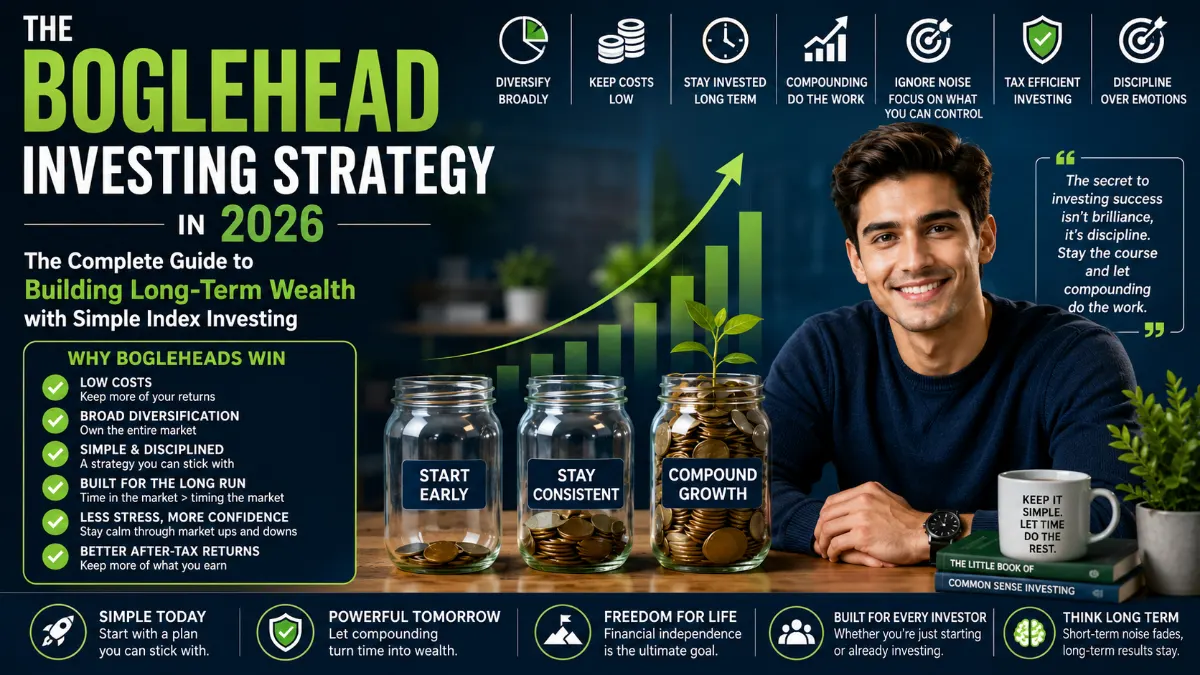
This philosophy is known as the Boglehead Investing Strategy
Named after John C. Bogle, the founder of Vanguard and the pioneer of modern index fund investing, the Boglehead approach is built on a simple idea: instead of trying to beat the market, own the market
While this concept may sound almost too simple, decades of academic research and real-world market performance have demonstrated that low-cost diversified investing has consistently outperformed the majority of actively managed investment strategies over long periods
The Boglehead philosophy removes unnecessary complexity from investing. It encourages investors to ignore short-term market noise, avoid emotional decision-making, minimize investment costs, and allow compound growth to work over decades
This strategy is not designed to make investors rich overnight. Instead, it is designed to help ordinary peoplee steadily build wealth while reducing unnecessary risk and avoiding many of the mistakes that often prevent investors from reaching their financial goals
Whether you're investing your first paycheck, planning for retirement, or looking to simplify an existing portfolio, understanding the Boglehead investing strategy can provide a sharp framework for making better financial decisions throughout your lifetime
Who Was Johnn C. Bogle?
Every investing philosophy has a founder whose ideas changed the way people think about money. For passive investing, that person was John Clifton Bogle
John Bogle founded Vanguard Group in 1975 with a revolutionary mission: give investors a simple, low-cost way to participate in the long-term growth of financial markets without paying excessive Charges
During the 1960s and early 1970s, the investment industry was dominated by actively managed mutual funds. Professional fund managers attempted to outperform the market by researching companies, selecting stocks, and frequently adjusting portfolios
Investors willingly paid high management fees because they believed professional expertise would generate superior returns
However, Bogle carefully studied decades of investment performance and reached an important conclusion
Consistently beating the market was extremely difficult
Even when some professional fund managers succeeded for short periods, maintaining that success over decades proved remarkably Limited
Once management fees, trading costs, and taxes were considered, many actively managed funds underperformed simple market indexes
Bogle believed investors deserved a better alternative
Instead of paying professionals to attempt to outperform the market, he proposed that investors simply own the market itself
This idea led to the creation of the first publicly available index mutual fund
The concept was initially criticized by much of Wall Street. Critics argued that no investor would willingly settle for average market returns
Ironically, "average market returns" eventually turned out to outperform many expensive actively managed funds over long investment periods
As years passed, evidence continued to support Bogle's philosophy
Low-cost index investing became increasingly popular among individual investors, retirement plans, institutional investors, and financial advisors worldwide
Today, trillions of dollars are invested in index funds, and John Bogle is widely recognized as one of the most influential figures in the history of personal finance
His legacy is not simply about creating index funds
It is about changing how people think about investing
What Is the Boglehead Investing Strategy?
The Boglehead investing strategy is a long-term investment philosophy based on simplicity, diversification, discipline, and low investment costs
Rather than trying to identify the next winning stock or predict short-term market movements, Boglehead investors seek to own broadly diversified index funds that represent entire financial markets
Instead of asking,
"Which company will become the next trillion-dollar business?"
a Boglehead investor asks,
"How can I own thousands of successful businesses while minimizing costs and staying invested for decades?"
This subtle difference completely changes the investment process.
The strategy emphasizes controlling the factors investors can actually influence, including:
Investment expenses
Diversification
Savings rate
Asset allocation
Investment discipline
Long-term consistency
Market performance cannot be controlled.
Economic recessions cannot be predicted with certainty.
Interest rates change
Governments change
Technology changes
Markets experience both optimism and panic
Inflation rises and falls over time
Global events can affect financial markets unexpectedly
Rather than reacting emotionally to these events, Boglehead investors remain committed to their long-term investment plann
The Core Principles of the Boglehead Philosophy
Although the philosophy appears straightforward, it is built upon several powerful principles that have been supported by decades of financial research
Own the Entire Market
Instead of attempting to identify future winners, Boglehead investors purchase broad-market index funds that provide ownership in hundreds or thousands of companies
This approach recognizes an important reality
Nobody knows with certainty which companies will dominate the global economy twenty years from now
Some businesses will grow dramatically
Some companies will struggle or eventually disappear from the market
New industry leaders will emerge as innovation and consumer preferences evolve
Others will decline.
Some industries will disappear altogether
New industries will emerge
Owning the entire market allows investors to benefit from innovation without needing to predict where it will occurs
As companies succeed, they naturally become a larger portion of market indexes
Companies that struggle gradually lose influence or are replaced
The portfolio continuously evolves alongside the economy
Keep Costs as Low as Possible
Investment fees may appear insignificant in a single yearr
However, investing is measured in decades, not months
Even seemingly small annual expenses reduce the amount of money that remains invested and earning future returns
This creates a compounding effect in the opposite direction
Instead of your investments compounding, your fees compound
Reducing investment costs allows a greater percentage of your returns to remain invested
Over thirty or forty years, this difference can become substantial
John Bogle frequently reminded investors that while they cannot control future market returns, they can control how much they pay to participate in those returns
Keeping expenses low is one of the few investment advantages that is completely within an investor's control
Diversification Reduces Risk
Concentrating investments in a small number of companies or industries increases uncertainty
Even successful businesses can face unexpected challenges
Technological disruption, changing consumer preferences, regulation, competition, or economic downturns can significantly affect individual companies
Diversification reduces dependence on any single investment
By spreading investments across different sectors, industries, company sizes, and geographical regions, investors lower the impact of individual failures while maintaining exposure to overall economic growth
Diversification does not eliminate riskk
Markets will still Increase and Decline
However, it significantly reduces the likelihood that one poor investment decision will permanently damage an investor's financial future
Stay Invested
One of the most difficult aspects of investing is resisting emotional reactions during periods of market volatility
When markets decline sharply, fear encourages investors to Divest
When markets rise rapidly, excitement encourages investors to Invest additional capital
Unfortunately, emotional investing often produces poor results
Many investors purchase investments after prices have already increased and sell them after prices have already fallen
The Boglehead philosophy rejects thiss behavior
Instead of trying to predict market cycles, investors remain invested throughout economic expansions, recessions, inflationary periods, geopolitical uncertainty, and market recoveries
History has repeatedly shown that financial markets experience temporary declines, but patient investors have generally been rewarded over long investment horizons
Remaining invested allows compound growth to continue working without interruption
Invest Consistently
The Boglehead strategy places greater importance on regular investing than perfect market timing
Rather than waiting for the "right moment" to invest, followers of this philosophy contribute consistently according to a predetermined plans
This approach is commonly known as disciplined investing
During market declines, regular investments purchase more shares
During market rallies, contributions continue without emotional hesitation
Over many years, this consistent approach reduces the influence of short-term market fluctuations and helps investors gradually build wealth regardless of changing economic conditions
Consistency often proves more valuable than attempting to predict future market movements
Think Long Term
The Boglehead philosophy encourages investors to measure success over decades instead of weeks
Short-term market movements are unpredictable
Even experienced economists and professional investors cannot consistently forecast whatt financial markets will do over the next month or years
Long-term economic growth, however, has historically been driven by innovation, productivity, entrepreneurship, and business expansion
Patient investors participate in ongoing growth by remaining invested through changing market conditions
The longer the investment horizon, the less important daily price fluctuations become
Time, rather than prediction, becomes the most powerful factor in building wealth
Why the Boglehead Strategy Continues to Gain Popularity in 2026
Modern investors have access to more information than any previous generation
Artificial intelligence, financial news, social media platforms, and investment apps provide constant updates about markets around the world
While access to information has improved, it has also increased the temptation to react to every headline
Many investors now monitor their portfolios several times each day
Frequent monitoring often leads to unnecessary trading, emotional decision-making, and higher investment costs
The Boglehead philosophy offers a refreshing alternative
Instead of attempting to process every market prediction, investors focus on developing a sound investment plan, maintaining diversification, minimizing costs, and allowing time to work in their favor
This approach reduces stress while encouraging disciplined financial behavior
In an increasingly complex financial world, simplicity has become one of the greatest investment advantages
Why Simplicity Often Wins
Many people assume successful investing requires advanced mathematical models, sophisticated algorithms, or constant market analysis
In reality, many investment mistakes occur because investors make unnecessary changes to otherwise sound portfolios
Simple investment strategies are easier to understand
They are easier to maintain
Most importantly, they are easier to follow during periods of market uncertainty
Long-term wealth is rarely created by making hundreds of brilliant investment decisions
It is more often created by making a few sensible decisions and repeating them consistently over many years
That simple idea lies at the heart of the Boglehead investing strategy and explains why millions of investors continue to embrace this philosophy in 2026
Building a Portfolio That Can Last for Decades
One of the biggest misconceptions about investing is that a successful portfolio needs to be complicated
Many beginners believe they need to own dozens of ETFs, constantly rotate between sectors, or follow the latest investment trends to maximize returns. In reality, complexity often creates confusion rather than better performance
The Boglehead philosophy takes the opposite approach
Instead of constantly searching for the next winning investment, it focuses on building a portfolio that is diversified enough to benefit from long-term economic growth while remaining simple enough to manage for decades
The objective is not to create the most exciting portfolio
The objective is to create one that you can confidently hold through market booms, recessions, inflation, interest-rate cycles, technological revolutions, and economic uncertainty
A portfolio only works if you continue to own it
That is why simplicity is one of the greatest strengths of the Boglehead strategy
Understanding the Three Fundamental Asset Classes
Every diversified investment portfolio is built using a combination of different asset classes
Each serves a unique purpose and contributes differently during changing market environments
The first asset class consists of domestic equities, representing ownership in publicly traded companies within your home market
These businesses range from mature multinational corporations to rapidly growing smaller companies
As economies expand and businesses become more productive, shareholders participate in that growth through increasing company values and dividends
The second asset class consists of international equities
Economic growth is not limited to a single country
Innovation occurs across Europe, Asia, North America, South America, and emerging markets
International investing provides exposure to businesses operating under different economic conditions and helps reduce reliance on one country's economy
The third asset class consists of high-quality bonds
Unlike stocks, bonds are primarily designed to provide stability
Although they generally produce lower long-term returns than equities, they often experience smaller price fluctuations during periods of market stress
When combined appropriately, these three asset classes create a portfolio capable of balancing growth with risk management
Why Diversification Works
Diversification is often described as the only Without charge lunch in investing
Its purpose is not to maximize returns Annually
Its purpose is to reduce unnecessary riskk
No individual company is guaranteed to succeed forever
History contains countless examples of once-dominant corporations that eventually lost their competitive advantages
Likewise, entire industries can experience prolonged periods of underperformance while new sectors emerge
Rather than attempting to predict which businesses will dominate future decades, diversified investors participate in the overall growth of the economy
Some companies will exceed expectations
Others will disappoint
Because diversified portfolios own thousands of businesses, the success of a few companies does not determine the portfolio's future
The economy continuously evolves, and diversified portfolios evolve with it
Avoiding Concentration Risk
Many investors unknowingly create concentrated portfolios
For example, someone who invests heavily in a single industry because it has recently delivered exceptional returns may become exposed to significant downside risk if market conditions change
Technology has experienced remarkable growth over the past decade, but history reminds us that every sector experiences periods of rapid expansion followed by slower growth
Energy, financial services, healthcare, consumer goods, manufacturing, and artificial intelligence have all experienced different leadership cycles throughout market history
A well-diversified portfolio recognizes that leadership changes
Instead of betting everything on today's strongest performers, Boglehead investors maintain exposure to multiple industries simultaneously
This reduces dependence on any one sector while allowing investors to benefit from future economic shifts
Choosing an Asset Allocation
Asset allocation is the process of deciding how much of your portfolio should be invested in stocks and how much should be allocated to bonds
It is one of the most important decisions an investor will ever makee
Unlike selecting individual securities, asset allocation directly influences how a portfolio behaves during both strong markets and market downturns
Investors with longer investment horizons often choose portfolios that emphasize stocks because they have more time to recover from temporary market declines
Those approaching retirement may gradually increase their allocation to bonds in order to reduce volatility and preserve accumulated wealth
The appropriate allocation depends on several factors
Age is important
Income stability matters
Financial goals influence decision-making
Risk tolerance also plays a significant rolee
Most importantly, investors should choose an allocation they can maintain during difficult market environments
The best portfolio is not necessarily the one with the highest expected returns
It is the one an investor can consistently hold without making emotional decisions
The Importance of Keeping Investment Costs Low
Investment costs are one of the few variables investors can control
Market returns fluctuate
Economic conditions change
Inflation rises and falls
Interest rates move unpredictably
Investment expenses, however, are known in advance
Every dollar paid in fees represents money that no longer remains invested
Because investing relies on compounding over many years, even small annual expenses gradually reduce Build lasting wealth
Lower investment costs allow more capital to remain invested, producing additional returns Through market cycles
This seemingly small difference becomes increasingly significant over decades
Keeping costs low is not about saving a few dollars today
It is about maximizing the amount of wealth that remains invested for yours future
Why Dollar-Cost Averaging Is So Effective
One of the greatest obstacles facing new investors is uncertainty
Many hesitate because they worry markets are currently too expensive
Others postpone investing while waiting for prices to decline
Unfortunately, predicting short-term market movements is extremely difficult
Dollar-cost averaging removes this uncertainty
Instead of trying to identify the perfect time to invest, investors contribute fixed amounts of money at regular intervals
When markets decline, those contributions purchase more shares
When markets rise, they purchase fewer shares
Over time, this creates an average purchase price while eliminating the emotional stress associated Via market timing
Regular investing also helps establish financial discipline
Saving and investing become routine habits rather than occasional decisions influenced by market sentiment
Staying Invested During Bear Markets
Bear markets are inevitable
Every long-term investor will experience periods when portfolio values decline significantly
During these times, financial news often becomes increasingly pessimistic
Predictions of prolonged recessions become common
Some investors panic and sell their investments, hoping to avoid additional losses
Unfortunately, selling during periods of fear often locks in temporary declines while preventing participation in future recoveries
The Boglehead philosophy views market declines differently
Lower prices represent temporary fluctuations rather than permanent failures
Businesses continue operating
Employees continue working
Consumers continue spending
Innovation continues
Economic growth eventually resumes
History has repeatedly demonstrated that patient investors who remain invested throughout market cycles have generally been rewarded over long investment horizons
Rebalancing Keeps Risk Under Control
Markets rarely move in straight lines
Over time, one portion of a portfolio may grow much faster than another
This naturally changes the portfolio's risk profile
Rebalancing restores the original investment allocation
If stocks have increased substantially relative to bonds, investors may reduce some equity exposure and increase bonds holdings
If bonds become overweight after a prolonged equity decline, adjustments may occur in the opposite direction
This disciplined process helps investors maintain consistent risk levels instead of allowing portfolios to become unintentionally aggressive or overly conservative
Rebalancing is not a prediction about future market performance
It is simply portfolio maintenance
The Tax Advantages of Long-Term Investing
Frequent trading creates more than emotional stress
It can also increase taxes and transaction costs
Long-term investing generally reduces unnecessary trading activity
Broad index funds naturally experience lower portfolio turnover because they track market indexes rather than constantly buying and selling securities
Lower turnover often improves tax efficiency while reducing administrative costs
Although tax laws differ across countries, patient investing frequently provides advantages compared with constant trading
Thinking about after-tax returns Instead of simply pre-tax performance encourages smarter financial decision-making
Mistakes That Prevent Investors From Building Wealth
The greatest threats to investment success rarely come from market crashes
More often, they result from investor behavior
Common investing mistakes include chasing the best-performing investments from recent years, abandoning a long-term investment strategy during periods of market volatility, attempting to predict every market correction or economic downturn, concentrating too much of a portfolio in a small number of companies or sectors, paying unnecessarily high investment costs that reduce long-term returns, and allowing fear, greed, or other emotions to drive financial decisions instead of following a disciplined, well-diversified investment plans. Over time, these mistakes can significantly reduce portfolio growth and make it more difficult to achieve Across multiple decades financial goals
Many investors spend years searching for the perfect investment while neglecting the habits that actually build wealth
Successful investing depends far more on consistency than prediction
The discipline to continue investing through changing economic conditions often matters more than finding the next high-performing stocks
Investing Is a Lifetime Process
Perhaps the most valuable lesson of the Boglehead philosophy is that investing is not a competition
It is a lifelong process
Financial markets will experience periods of optimism and pessimism
New industries will emerge
Old industries will decline
Economic policies will change
Technology will continue evolving
Through all of these changes, disciplined investors remain focused on what they can control: saving consistently, maintaining diversification, minimizing costs, and allowing time to work in their favor
Over several decades, these simple principles have helped countless investors build meaningful wealth—not because they predicted the future, but because they remained committed to a proven Across multiple decades strategy
Investing Is About Time, Not Timing
One of the most valuable lessons of the Boglehead philosophy is that successful investing depends far more on time than on perfect timing
Many investors spend years trying to predict when markets Willl fluctuate Theyy wait for the "perfect" opportunity to invest, believing that buying at exactly the right moment will dramatically improve their Sustainable portfolio growth
Unfortunately, financial markets rarely move according to expectations
Unexpected economic reports, interest-rate decisions, geopolitical events, technological breakthroughs, corporate earnings, and investor sentiment constantly influence prices. Even professional fund managers with extensive research teams struggle to predict these short-term movements consistently
The Boglehead philosophy encourages investors to stop focusing on short-term predictions and instead concentrate on remaining invested for many years
Time allows investments to recover from temporary declines
Time allows businesses to groww
Time allows dividends to be reinvested
Most importantly, time allows compound growth to become increasingly powerful
For patient investors , patience often becomes one of the greatest competitive advantages.
Why Emotional Investing Destroys Wealth
Financial markets naturally create emotional reactions
When stock prices rise rapidly, excitement encourages investors to buy moree
Sharp market declines can trigger fears, prompting many investors to sell their holdings and locks in losses.
Unfortunately, these emotional decisions often occur at exactly the wrong time.
History has repeatedly shown that many investors buy after significant market rallies and sell after substantial declines
This behavior often creates a costly investing cycle in which individuals buy assets only after prices have risen significantly and then sell during market downturns when fear and uncertainty are at their highest. As a result, investors frequently purchase at higher valuations and sell at lower prices, reducing the benefits of long-term compounding. Over time, this pattern can erode portfolio performance, limit wealth accumulation, and make it far more difficult to achieve long-term financial goals. Breaking this cycle by maintaining a disciplined investment strategy and focusing on long-term market growth is one of the key principles of successful investing
The Boglehead philosophy attempts to remove emotions from investing by encouraging investors to establish a long-term plan before market volatility occurs
Instead of reacting to headlines, disciplined investors continue following their investment strategy regardless of temporary market movements
Maintaining this disciplined approach often leads to stronger long-term investment results than constantly changing direction in response to short-term market news, economic headlines, or temporary market volatility. Investors who remain focused on their long-term financial goals are generally better positioned to benefit from compounding, market recoveries, and sustained economic growth, rather than being distracted by short-term market fluctuations
Why Chasing Market Trends Rarely Works
Every year, a different investment captures public attention
Sometimes it is artificial intelligence
Sometimes it is clean energy
Other times it may be biotechnology, electric vehicles, commodities, or cryptocurrencies
After experiencing strong returns, these sectors often attract large numbers of new investors who hope recent performance will continue indefinitely
The problem is that markets constantly evolve
Today's strongest-performing sector may not remain tomorrow's leader
Companies that appear unstoppable today can eventually experience slower growth, lose market share, or face increasing competition from innovative businesses and emerging industries. Changes in technology, consumer behavior, government regulations, and global economic conditions can significantly reshape entire sectors over time. History has shown that many once-dominant companies eventually declined, while new market leaders emerged to replace them. For this reason, relying too heavily on a small number of companies can increase investment risk, whereas broad-market index funds help investors benefit from the growth of both today's industry leaders and tomorrow's successful businesses
Entire industries can experience years of underperformance before recovering
The Boglehead philosophy avoids concentrating investments in whatever happens to be popular at the moment
Instead, it emphasizes owning a broadly diversified portfolio capable of benefiting from economic growth regardless of which sectors become future leaders
The Power of Compound Growth
Albert Einstein is often credited with describing compound interest as one of the most powerful forces in finance
Whether or not the quotation is historically authentic, the underlying investment principle remains as relevant today as ever. Long-term investing success is rarely achieved by accurately predicting short-term market movements, chasing the latest investment trends, or reacting emotionally to economic headlines. Instead, it is built on proven principles such as broad diversification, disciplined investing, minimizing investment costs, maintaining a consistent asset allocation, and allowing the power of compound growth to work over many years. Investors who remain focused on these fundamentals are generally better positioned to navigate market volatility, benefit from long-term economic growth, and build lasting wealth while avoiding many of the common mistakes that reduce investment returns
Compounding occurs when investment returns begin generating additional returns
Initially, investment growth may appear slow, and the progress can sometimes feel disappointing, especially during periods of market volatility or modest returns. However, consistent investing, regular contributions, and the power of compound growth typically become more noticeable over time. As investment earnings begin generating additional earnings, portfolio growth often accelerates, allowing patient investors to build substantial wealth over the long run despite short-term market fluctuations
However, as years pass, the accumulated returns themselves begin producing additional growth
This creates a snowball effect
The longer investments remain untouched, the greater the impact of compounding becomes
This is one of the key reasons why starting to invest early can have a significant impact on long-term wealth creation and financial independence. Time is one of the most powerful advantages available to investors because it allows compound growth to work more effectively. When you invest consistently over many years, your returns can generate additional returns, creating a snowball effect that can substantially increase your portfolio value overr timee
Starting early also provides greater flexibility because investors do not need to rely on aggressive strategies or excessive risk-taking to build wealth. Even small, regular contributions made at a young age can accumulate into meaningful amounts due to the combination of time, consistency, and compounding. In contrast, investors who delay investing may need to contribute significantly more money later to achieve similar financial goals
While market conditions will always change, and short-term fluctuations are unavoidable, maintaining a long investment horizon allows investors to focus on steady progress rather than temporary market movements. This is why beginning early, investing consistently, and staying disciplined are considered some of the most important principles for building sustainable wealth over the Multi-year period
Even modest but consistent investments can grow substantially when given sufficient tiime
The Boglehead strategy is specifically designed to allow compound growth to operate without unnecessary interruptions caused by excessive trading or emotional decision-making
Why Patience Is an Investor's Greatest Asset
Many people believe investing is about making brilliant predictions
In reality, successful investing often requires the opposite
It requires patience
Markets will not increase every years
Corrections are normal
Bear markets are inevitable
Economic uncertainty periodically returns
These events can be uncomfortable, but they are also temporary
Patient investors understand that temporary declines are part of long-term investing rather than evidence that their strategy has failed
Instead of abandoning their investment plan during periods of uncertainty, they continue focusing on their long-term objectives
Patience allows investors to benefit from future recoveries while avoiding costly emotional mistakes
Common Mistakes That Prevent Long-Term Success
Many investment mistakes have little to do with selecting the wrong fund or choosing the wrong company
Instead, they result from poor financial habits
One common mistake is checking investment accounts too frequently
Daily monitoring encourages emotional reactions to normal market fluctuations
Another mistake is believing every market prediction published online or discussed in financial media
No individual can consistently forecast short-term market movements with complete accuracy
Some investors also change strategies every few months after reading about a new investment trend
Constantly switching approaches prevents the long-term consistency necessary for compound growth
Others underestimate the impact of investment costs
Even small annual expenses gradually reduce wealth over time because those costs continue compounding year after years
Perhaps the most damaging mistake is abandoning long-term investing after experiencing temporary losses
Markets recover.
Investors who remain disciplined often participate in those recoveries
Those who permanently leave the market may not
Is the Boglehead Strategy Suitable for Every Investor?
Although the Boglehead philosophy has helped millions of investors build wealth, it is not designed for every personality
Investors who enjoy daily trading, short-term speculation, or attempting to outperform the market through frequent buying and selling may find the strategy too conservative
The philosophy also requires emotional discipline
There will be years when markets produce disappointing returns
There will be periods when speculative investments appear to outperform diversified portfolios
Maintaining patience during these times requires confidence in the Extended investment process
For individuals focused on building wealth steadily over decades rather than seeking rapid profits, the Boglehead approach remains one of the most practical investment philosophies available
Practical Steps for Getting Started
Beginning a long-term investment journey does not require predicting future market conditions
The first step is establishing clear financial goals
Knowing why you are investing helps determine how muchh riskk you can comfortably accept and how long your investments should remain invested
The next step is creating an emergency savings reserve
Having accessible savings reduces the likelihood of selling long-term investments during unexpected financial emergencies
After that, determine an appropriate investment allocation based on your personal circumstances
Invest regularly rather than waiting for ideal market conditions
Keep investment costs as low as reasonably possible
Review your portfolio periodically instead of constantly
Finally, remain committed to your investment strategy even when markets become volatile
Long-term success usually comes from consistently following these habits rather than making dramatic investment decisions
Frequently Asked Questions
Is the Boglehead strategy beginner friendly?
Yes. Its emphasis on simplicity, diversification, and long-term investing makes it particularly suitable for investors with limited experience
Can I begin investing with a small amount?
Absolutely. Consistency is generally more important than the size of the initial investment
Does this strategy require constant monitoring?
No. One of its primary advantages is reducing the need for frequent trading or daily portfolio management
Is this approach only useful for retirement planning?
No. It can support many long-term financial goals, including education planning, financial independence, wealth accumulation, and future lifestyle expenses
What makes this strategy different from active investing?
Rather than attempting to outperform financial markets, it focuses on participating in long-term market growth while minimizing costs and unnecessary trading
How often should an investment portfolio be reviewed?
Periodic reviews are generally sufficient. The emphasis should remain on maintaining long-term discipline rather than reacting to daily market mov
Final Thoughts
The Boglehead investing strategy has earned the respect of millions of investors because it is built on timeless financial principles rather than short-term predictions
Markets will always experience periods of optimism and uncertainty
Economic cycles will continue
New technologies will emerge
Industries will evolve
No investment strategy can eliminate these realities
What investors can control are their own decisions
They can save consistently
They can invest regularly
They can diversify broadly
They can minimize unnecessary costs
They can remain patient during periods of volatility
These seemingly simple habits have historically proven more valuable than attempting to predict every market movement
Building wealth rarely happens overnight
It is usually the result of thousands of small, disciplined financial decisions made over many years
The Boglehead philosophy reminds us that successful investing does not require extraordinary intelligence, constant trading, or complicated financial products
Instead, it requires patience, consistency, and the confidence to trust a well-designed long-term investment plans
For investors seeking a straightforward, evidence-based approach to building wealth in 2026 and beyond, the Boglehead strategy remains one of the most enduring and practical investment philosophies ever developed
Recommended Articles
If you want to continue building your investing knowledge and create a stronger long-term financial plan, these guides can help:
- Best Index Funds to Invest in 2026
- How to Build a Personal Financial Plan in 2026
- How to Build Wealth in 2026
- How Much Should Your Emergency Fund Be in 2026?
- Recession-Proof Investment Portfolio in 2026
- How to Protect Your Money From Inflation in 2026
- How the Ultra-Wealthy Invest: Core and Satellite Strategy
- How Much Money Do You Need to Retire Comfortably in 2026?
- How Much Cash Millionaires Keep in the Bank
- Build Wealth During Economic Uncertainty in 2026
Recommended Tools
Take advantage of these free financial tools to make smarter investing decisions and stay on track with your long-term wealth-building goal.
Net Worth Calculator
Track your assets and liabilities to measure your financial progress over time. Monitoring your net worth is one of the best ways to stay motivated while following the Boglehead investing philosophy
Tools: /calculators/net-worth
Cost of Living Calculator
Understanding your monthly living expenses helps determine how much you can consistently invest. Lower expenses often mean a higher savings rate—one of the core principles of the Boglehead strategy
Tools: /calculators/living-cost
Financial Guides Hub
Explore comprehensive investing, retirement, budgeting, and wealth-building guides designed to help you become a better long-term investor
Resource: /guides
Latest Financial News
Stay informed about major economic events, interest rates, inflation, and market trends without reacting emotionally to short-term volatility.
Resource: /news
Personal Finance Calculators
Access all of our financial calculators to estimate your savings, evaluate your financial health, and make informed investment decisions
Tools Hub: /calculators
🔥 Continue Your Wealth-Building Journey
Want to make sure you stay ahead of volatile financial shifts and cutting-edge tech integrations?
Explore the main Virearn platform for continuous, up-to-the-minute updates on fintech automation, global asset trends, and strategic wealth-building protocols If you find our free tools and deeply researched material valuable, please consider supporting our independent platform via our donate portal Stay ahead, stay automated, and keep your money working for you