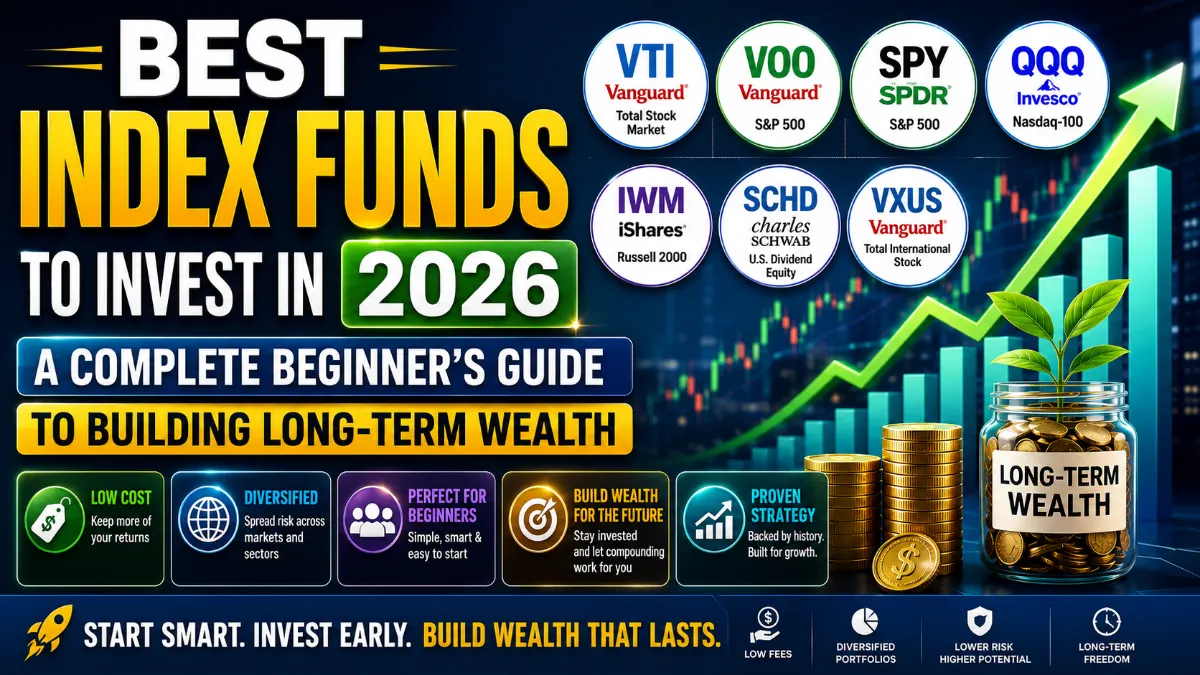
Investing has never been more accessible than it is today. Whether you're just starting your financial journey or looking to strengthen an existing portfolio, index funds continue to be one of the smartest investment options available. As markets evolve in 2026 with artificial intelligence, technological innovation, and changing economic conditions shaping the global economy, investors are increasingly searching for reliable ways to grow their wealth without constantly buying and selling stocks
That is exactly why index funds remain one of the most recommended investment vehicles by economists, financial advisors, and long-term investors. Instead of trying to predict which individual company will outperform the market, index funds allow you to invest in hundreds—or even thousands—of companies through a single investment. This provides instant diversification while keeping costs remarkably low
Many of the world's wealthiest investors, including Warren Buffett, have consistently emphasized the importance of low-cost index investing for everyday investors. History has shown that consistently investing in broad-market index funds often outperforms the majority of actively managed funds over long periods
If your goal is financial freedom, retirement planning, or simply growing your money steadily over time, understanding the best index funds to invest in during 2026 can help you make informed decisions
Before choosing your investments, it's also important to have a solid financial foundation. If you're just beginning your wealth-building journey, you may want to read our guide on How to Build Wealth From Zero in 2026
What Is an Index Fund?
An index fund is an investment fund designed to track the performance of a specific market index rather than attempting to beat it
For example, instead of purchasing shares of hundreds of individual companies in the S&P 500, an S&P 500 index fund owns those compnies for you. When the overall market grows, your investment generally grows alongside it
This passive investment strategy eliminates the need to constantly research individual stocks or frequently trade your portfolio
Some of the most popular indexes include:
Are mentioned below
S&P 500
Nasdaq-100
Total Stock Market Index
MSCI World Index
Russell 2000
FTSE Developed Markets Index
Each index represents a different segment of the market, allowing investors to choose funds that align with their financial goals and risk tolerance
Why Index Funds Continue to Dominate in 2026
Several major investment trends continue supporting index investing
Low Investment Costs
One of the biggest advantages is the extremely low expense ratio. Since index funds simply follow an existing index instead of employing teams of analysts to pick stocks, operating costs remain significantly lower
Lower fees allow more of your investment returns to stay in your portfolio
Broad Diversification
Buying one index fund can provide exposure to hundreds or even thousands of companies across multiple industries
Instead of relying on one company's success, your investment benefits from the overall strength of the economy
Diversification helps reduce company-specific risk while improving long-term portfolio stability
Strong Historical Performance
Over multiple decades, broad-market index funds have consistently delivered competitive long-term returns
While short-term volatility is unavoidable, patient investors who remain invested have historically benefited from economic growth over time
Simplicity
Index investing removes much of the stress associated with investing.
You don't need to:
Predict market crashes
Pick winning stocks
Monitor earnings every quarter
Trade daily
Constantly adjust your portfolio
Instead, you can focus on consistently investing and allowing compounding to work
Excellent for Beginners
Many new investors lose money because they chase trends or attempt to time the market
Index funds encourage disciplined investing through regular contributions and long-term thinking
How Index Funds Generate Wealth
Index funds create wealth primarily through three mechanisms
Capital Appreciation
As the companies inside the index grow, the overall value of the fund generally increases
Dividend Income
Many companies distribute dividends to shareholders
Index funds collect these dividends and either distribute them or automatically reinvest them depending on the fund structure
Dividend reinvestment significantly accelerates long-term wealth creation
Compound Growth
Perhaps the most powerful factor is compounding
Returns generate additional returns over decades, allowing portfolios to grow exponentially
Even modest annual contributions can become substantial over a 20- to 30-year investment horizon
If you're creating a complete financial roadmap, our guide on
[What Is Personal Financial Planning?]( https://virearn.com/what-is-personal-financial-planning complements this strategy:
Best Index Funds to Invest in 2026
Let's explore some of the strongest index funds that continue attracting long-term investors worldwide
Vanguard S&P 500 ETF (VOO)
The Vanguard S&P 500 ETF remains one of the most respected investment funds globally
It tracks the S&P 500 Index, giving investors ownership in approximately 500 of America's largest publicly traded companies
Major holdings typically include leading businesses across technology, healthcare, finance, consumer goods, communication services, and industrial sectors
Why Investors Like It
Extremely low expense ratio
Excellent long-term performance
High liquidity
Strong diversification
Ideal for retirement investing
This fund is often considered the foundation of a long-term investment portfolio
Vanguard Total Stock Market ETF (VTI)
Unlike an S&P 500 fund, VTI provides exposure to nearly the entire U.S. stock market
Instead of owning only large companies, investors also gain exposure to:
Large-cap companies
Mid-cap companies
Small-cap companies
Emerging businesses
Exposure to more than 3,500 U.S. companies across a wide range of industries and sectors
Weighted by market capitalization, allowing successful companies to naturally make up a larger share of the portfolio
This broader diversification makes VTI attractive for investors seeking complete exposure to the U.S. equity market
Schwab U.S. Broad Market ETF (SCHB)
SCHB offers another excellent low-cost way to invest in thousands of American companies
It provides diversified exposure across nearly every major economic sector
Its low expense ratio and simple investment strategy have made it increasingly popular among long-term investors
Ideal for investors who prefer simplicity without sacrificing diversification
Tracks the Dow Jones U.S. Broad Stock Market Index, covering thousands of publicly traded U.S. companies
Suitable as a core long-term portfolio holding, helping investors build wealth through broad market exposure
Fidelity ZERO Large Cap Index Fund (FNILX)
Fidelity disrupted the investment industry by introducing zero-expense index funds
FNILX tracks large-cap U.S. companies while charging no management fee
For cost-conscious investors, eliminating investment expenses can improve long-term returns
Although its benchmark differs slightly from the traditional S&P 500, its overall investment objective remains similar
Provides exposure to many of the largest and most established U.S. companies across multiple sectors
Can serve as a strong core holding for long-term investors seeking broad large-cap market performance
Invesco QQQ Trust (QQQ)
QQQ tracks the Nasdaq-100 Index, which includes many of the world's leading technology companies
Although it is more concentrated than the S&P 500, it offers exposure to industries driving future innovation
Major sectors include:
Artificial Intelligence
Cloud Computing
Software
Semiconductor Manufacturing
Digital Payments
Cybersecurity
Investors seeking higher growth potential often allocate a portion of their portfolio to QQQ
However, because technology stocks tend to experience greater volatility, QQQ may fluctuate more during market downturns
Vanguard FTSE All-World ETF (VT)
For investors wanting global diversification, the Vanguard FTSE All-World ETF offers exposure to thousands of companies across developed and emerging markets
Instead of relying solely on the U.S. economy, VT includes businesses from countries across Europe, Asia-Pacific, Canada, and many emerging economies
This makes it an excellent choice for investors who believe global economic growth will remain an important driver of long-term returns
iShares Core MSCI Total International Stock ETF (IXUS)
While many investors focus heavily on U.S. companies, international markets can provide valuable diversification
IXUS invests in a broad range of companies outside the United States, including both developed and emerging markets. It can help reduce concentration risk and gives investors exposure to sectors and economies that may perform differently from the U.S. market over timee
Building wealth through investing works best when paired with strong financial habits. To strengthen your overall financial strategy, explore these additional Virearn guides:
How Much Should Your Emergency Fund Be in 2026?
What Is Lifestyle Inflation and Why Does It Keep People Broke?
More Top Index Funds to Consider in 2026
Whether you're investing for retirement, passive income, or long-term wealth creation, choosing a mix of funds based on your risk tolerance and investment horizon can strengthen your overall strategy.
iShares Core S&P 500 ETF (IVV)
The iShares Core S&P 500 ETF is another popular choice for investors who want exposure to the 500 largest publicly traded companies in the United States
Like Vanguard's VOO, IVV tracks the S&P 500 Index and offers:
Broad market exposure
Very low expense ratio
High liquidity
Strong historical performance
Backed by BlackRock, one of the world's largest asset management companies
Well-suited as a core long-term investment for retirement and wealth-building portfolios
For most long-term investors, choosing between IVV and VOO often comes down to personal preference, as both funds have delivered nearly identical long-term returns
Vanguard Growth ETF (VUG)
If you're looking for higher growth potential, the Vanguard Growth ETF focuses on companies with strong earnings growth prospects
Many of its holdings are leaders in sectors such as:
Artificial Intelligence
Cloud Computing
Digital Advertising
Software
Consumer Technology
Healthcare Innovation
Growth funds can outperform during strong bull markets, but they also tend to experience greater volatility during market corrections. Investors should be prepared for larger short-term price swings in exchange for potentially higher long-term returns
Vanguard Dividend Appreciation ETF (VIG)
For investors seeking a combination of growth and income, the Vanguard Dividend Appreciation ETF is a compelling option
Rather than chasing the highest dividend yields, VIG invests in companies with a long history of consistently increasing their dividend payments
These businesses are often financially stable, profitable, and well-established, making them attractive during periods of market uncertainty
iShares Russell 2000 ETF (IWM)
Large-cap companies dominate many portfolios, but smaller businesses can also play an important role in long-term growth
The iShares Russell 2000 ETF tracks approximately 2,000 small-cap U.S. companies
Small-cap stocks generally offer:
Higher growth potential
Greater exposure to emerging industries
Increased volatility
More risk than large-cap companies
Broader exposure to the domestic U.S. economy through smaller businesses
Potential for stronger returns during certain market cycles when small-cap stocks outperform large-cap stocks
Investors with a long investment horizon may consider allocating a small percentage of their portfolio to small-cap index funds for additional diversification
How to Choose the Right Index Fund
No single index fund is perfect for everyone. The best choice depends on your financial goals, time horizon, and risk tolerance
Consider Your Investment Goal
Ask yourself why you're investing.
Are you saving for:
Retirement?
Financial independence?
A home purchase?
Your children's education?
Long-term wealth creation?
Your objective should guide your investment decisions
Think About Your Time Horizon
If retirement is decades away, you can typically afford to take more investment risk because you'll have time to recover from market downturns
If you'll need the money within the next few years, preserving capital may be more important than maximizing returns
Compare Expense Ratios
Even small differences in fees can significantly affect your portfolio over several decades
A lower expense ratio means more of your investment returns remain invested and continue compounding
Evaluate Diversification
Broad-market index funds generally provide better diversification than narrowly focused sector fundss
Holding investments across multiple industries and geographic regions can reduce portfolio riskk
Avoid Chasing Recent Performance
Many investors make the mistake of buying funds solely because they performed well over the past year
Past performance doesn't guarantee future results
Instead of chasing trends, focus on building a diversified portfolio that aligns with your long-term strategy
Should You Invest in International Index Funds?
Many investors naturally gravitate toward U.S. companies, but international markets can provide additional diversification
International index funds offer exposure to economies in Europe, Asia, Canada, Australia, and emerging markets
Potential benefits include:
Reduced concentration risk
Exposure to global economic growth
Diversification across currencies
Access to industries less represented in U.S. markets
Exposure to thousands of companies outside the United States, including both developed and emerging markets
Potential to reduce portfolio volatility by spreading investments across multiple regions and economies
While international markets may experience periods of underperformance, they can also outperform U.S. markets during different economic cycles
Index Funds vs. Individual Stocks
Many beginners wonder whether they should invest in individual companies or index funds
Individual stocks can deliver exceptional returns if you choose the right companies. However, they also carry much higher risk because the performance of your investment depends on the success of a limited number of businesses
Index funds spread your investment across hundreds or thousands of companies. This diversification reduces company-specific risk and allows your portfolio to benefit from the overall growth of the market
For most long-term investors, index funds provide a more reliable and less stressful path to wealth creation
Index funds require little ongoing research, while investing in individual stocks often demands continuous analysis and monitoring
Many professional fund managers struggle to consistently outperform broad market index funds over long periods, making index investing an attractive strategy for many investors
Common Mistakes to Avoid
Even though index funds are relatively simple investments, investors often make avoidable mistakes that can reduce long-term returns
Trying to Time the Market
Waiting for the "perfect" time to invest often results in missed opportunities
Consistently investing over time is generally more effective than attempting to predict short-term market movements
Investing Without an Emergency Fund
Before investing aggressively, make sure you have sufficient cash reserves for unexpected expenses
Without an emergency fund, you may be forced to sell investments during a market downturn
Learn how much cash you should keep by reading our guide:
How Much Should Your Emergency Fund Be in 2026?
Ignoring Asset Allocation
Owning only one type of investment can increase portfolio riskk
A diversified mix of U.S. stocks, international stocks, and bonds may provide a smoother investment experience over the long term
Selling During Market Corrections
Market declines are a normal part of investing
History shows that investors who remain disciplined during downturns often benefit when markets recover
Panic selling can permanently lock in losses
A Simple Long-Term Investing Strategy
If you're new to investing, you don't need a complicated portfolio
A straightforward approach may include:
A broad U.S. stock market index fund
An international stock index fund
A bond index fund (depending on your age and risk tolerance)
Contributing consistently every month, reinvesting dividends, and avoiding emotional decisions are often more important than finding the "perfect" funds
Why Index Funds Are Ideal for Wealth Building in 2026
Economic conditions may change, interest rates may fluctuate, and market sentiment will continue to evolve
However, one principle remains consistent:
Successful investing is less about predicting the next market winner and more about participating in long-term economic growth
Index funds allow investors to do exactly thatt
By keeping costs low, maintaining diversification, and staying invested through market cycles, index funds provide a disciplined framework for building wealth over decades
If you're also working toward financial independence, explore these related guides on Virearn:
7 Income Streams of Millionaires in 2026
Capital Gains Taxes 2026: How Smart Investors Keep More of Their Wealth
Build Wealth During Economic Uncertainty in 2026
These resources complement an index investing strategy by helping you diversify income, minimize taxes, and stay focused during volatile markets
Together, these guides provide practical strategies for growing wealth, optimizing your investments, reducing unnecessary taxes, and achieving your long-term financial goals
Frequently Asked Questions
Are index funds safe?
Index funds are generally considered less risky than investing in individual stocks because they hold many companies. However, they are still subject to market risk and can lose value during market downturns
How much money do I need to start investing in index funds?
Many brokerages allow investors to start with very small amounts through fractional shares or automatic investment plans. The key is to invest consistently rather than waiting until you have a large sum
Are ETFs and index funds the same?
Not exactly. An index fund refers to the investment strategy of tracking an index. Many index funds are structured as ETFs, while others are traditional mutual funds. Both can be excellent choices depending on your needs
Should beginners invest only in index funds?
For many beginners, broad-market index funds are an excellent starting point because they offer diversification, low costs, and simplicity
Can index funds pay dividends?
Yes. Many index funds distribute dividends received from the companies they own. Investors can choose to receive these payments or reinvest them for additional growth
How often should I invest?
A consistent schedule, such as monthly investing through dollar-cost averaging, can help reduce the impact of short-term market fluctuations
Are international index funds worth it?
International funds can improve diversification by providing exposure to markets outside your home country. While they may perform differently from domestic markets, they can add balance to a long-term portfolio
What is the biggest advantage of index investing?
Low costs, diversification, and the ability to capture overall market growth make index funds one of the most effective long-term investment strategies
Can I become wealthy by investing only in index funds?
Many investors have built substantial wealth through disciplined, long-term investing in low-cost index funds combined with regular contributions and patience
Should I sell my index funds during a market crash?
Selling during a market downturn can lock in losses. Long-term investors often stay invested and continue contributing, allowing them to benefit when markets recover
Conclusion
Index funds continue to stand out as one of the smartest investments for 2026 because they combine simplicity, diversification, and cost efficiency. Rather than trying to predict which individual stocks will outperform, investors can participate in the long-term growth of entire markets through a single investment
Whether you choose an S&P 500 index fund, a total stock market fund, an international index fund, or a combination of these, the most important factor is consistency. Investing regularly, reinvesting dividends, keeping costs low, and maintaining a long-term perspective can have a profound impact on your financial future
Remember, successful investing isn't about reacting to every headline or market fluctuation—it's about building a disciplined strategy that aligns with your goals. Over time, patience and compounding can become your greatest financial allies
By pairing index fund investing with sound financial planning, an emergency fund, multiple income streams, and tax-efficient strategies, you'll be better positioned to build lasting wealth and achieve financial independence
Trying to predict short-term market movements is extremely difficult, even for experienced investors. Staying invested through different market cycles has historically been one of the most effective ways to build long-term wealth
You don't need thousands of dollars to begin investing in index funds. Many brokers allow investors to start with small amounts, making it easier to build good investing habits regardless of income
While index investing is largely a passive strategy, reviewing your portfolio once or twice a year can help ensure your investments remain aligned with your financial goals and desired asset allocation
Financial markets evolve over time, and continuing to improve your knowledge can help you make better investment decisions. Understanding topics such as taxes, diversification, and risk management can further strengthen your long-term strategy
Financial success rarely happens overnight. By consistently investing in quality index funds, remaining patient during market volatility, and allowing compounding to work over decades, you can steadily move closer to financial independence and long-term wealth
Short-term market swings are inevitable, but long-term investors are generally rewarded for remaining patient. Keeping your attention on your financial goals rather than daily market news can help you avoid emotional decisions
Consistently investing every month through dollar-cost averaging can reduce the impact of market volatility and help you accumulate wealth over time
Automatically reinvesting dividends allows your investments to purchase additional shares, increasing the power of compound growth over the long run
The latest hot stock or investment trend may seem attractive, but building wealth usually comes from sticking to a disciplined investment strategy instead of constantly changing direction
Expense ratios, trading fees, and unnecessary taxes can reduce your long-term returns. Choosing low-cost index funds allows more of your money to remain invested and continue growing
Owning a diversified portfolio across different sectors, company sizes, and global markets can help reduce risk while improving the stability of your long-term investment strategy
One of the biggest advantages an investor can have is time. Even modest investments made consistently over many years can grow into substantial wealth through the power of compounding. Starting early is often more important than trying to invest the perfect amount
🔥 Continue Your Wealth-Building Journey
Want to make sure you stay ahead of volatile financial shifts and cutting-edge tech integrations?
Explore the main Virearn platform for continuous, up-to-the-minute updates on fintech automation, global asset trends, and strategic wealth-building protocols If you find our free tools and deeply researched material valuable, please consider supporting our independent platform via our donate portal Stay ahead, stay automated, and keep your money working for you