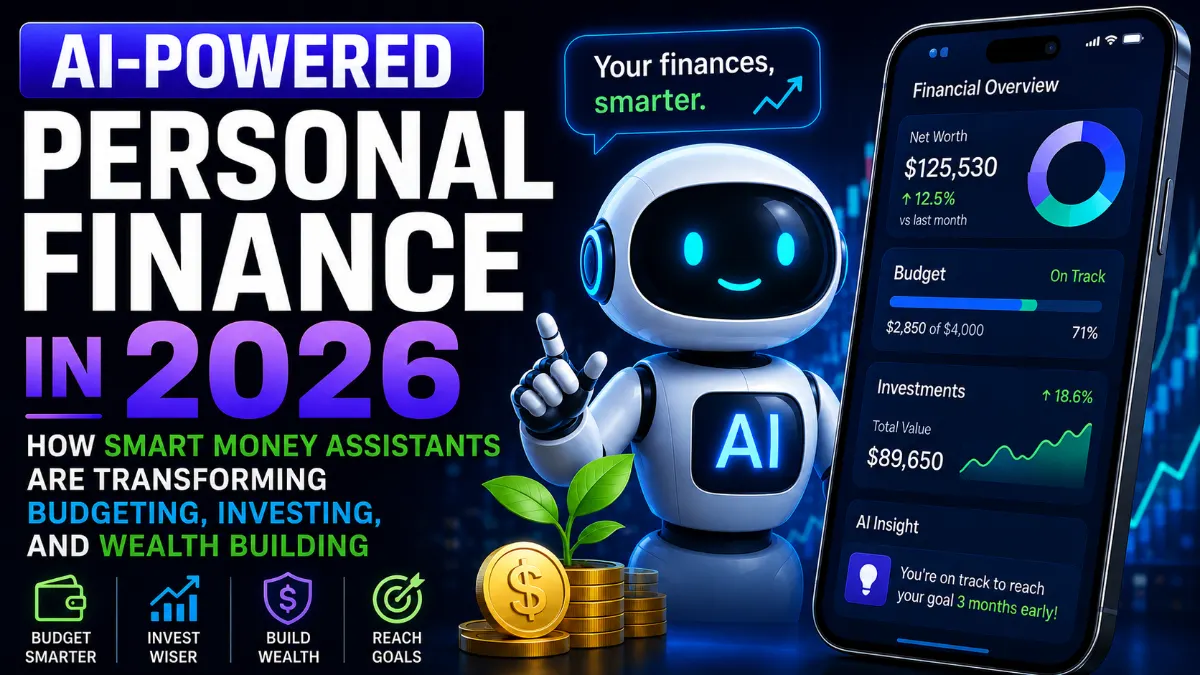
Introduction: Your Money Just Got Smarter
A decade ago, managing your finances meant manually tracking expenses, balancing spreadsheets, setting reminders for bills, and spending hours researching investment opportunities. Most financial decisions relied heavily on personal judgment, financial advisors, or countless hours reading blogs and watching videos.
Fast forward to 2026, and the landscape has changed dramatically.
Artificial intelligence is no longer just powering chatbots or generating images. It has quietly become one of the most influential technologies in personal finance. Millions of people now rely on AI-powered financial assistants to create budgets, monitor subscriptions, identify unnecessary expenses, recommend investment strategies, optimize taxes, improve credit scores, and even negotiate bills automatically. The broader impact of AI across the global economy is already reshaping industries, as discussed in How Artificial Intelligence Is Quietly Reshaping Global Trade
Instead of asking, "How much did I spend this month?", users now ask AI:
"Can I afford a vacation next month?"
"How much should I invest if I want to retire by 55?"
"What's the smartest way to pay off my debt?"
"Can I save $10,000 this year without changing my lifestyle too much?"
Within seconds, AI generates personalized financial strategies based on income, spending habits, savings goals, market conditions, and historical financial behavior.
This shift represents one of the biggest transformations in personal finance since the rise of online banking.
In this guide, we'll explore how AI-powered personal finance is reshaping the way people manage money, the benefits and challenges of intelligent financial assistants, and practical tips to use these tools responsibly
Why AI Personal Finance Is Exploding in 2026
Several technological and economic trends have converged to accelerate AI adoption in finance.
Rising Cost of Living
Persistent inflation and higher living expenses have made budgeting more important than ever. Understanding how inflation affects everyday expenses can help households make smarter decisions, and ourCost of Living Index 2026 Guide explains these trends in greater detail.
Open Banking Expansion
Many financial institutions now allow secure APIs that let approved apps analyze account activity in real time, enabling AI tools to deliver highly personalized financial recommendations.
Better AI Models
Large language models have become more accurate at understanding financial questions, summarizing spending patterns, and generating actionable insights.
Mobile-First Banking
Most consumers now manage nearly every aspect of their financial lives through smartphones, making AI assistance available anytime.
Smarter Budgeting Without Manual Tracking
Traditional budgeting requires discipline.
Users often have to:
Save receipts
Enter transactions manually
Categorize expenses
Review reports
Many people stop budgeting after only a few weeks because the process feels tedious.
AI removes most of this friction.
Modern financial assistants automatically:
Import transactions
Categorize purchases
Identify recurring payments
Detect duplicate charges
Suggest spending limits
Send real-time alerts
Instead of updating spreadsheets every weekend, users receive instant insights directly on their phones. You can also monitor your overall financial progress using Virearn's Net Worth Calculator to see how your assets and liabilities change over time
Personalized Saving Strategies
Saving money is easy in theory.
Doing it consistently is much harder.
AI makes saving automatic by understanding your cash flow.
Instead of transferring the same amount every month, intelligent assistants calculate what you can safely save based on:
Upcoming bills
Spending history
Income schedule
Seasonal expenses
Emergency fund targets
For example:
If your paycheck is higher than usual, AI may recommend increasing savings temporarily.
If large bills are approaching, it may reduce transfers automatically.
This dynamic approach helps users save without creating unnecessary financial stress. Readers looking to accelerate wealth creation can also explore 7 Income Streams of Millionaires for additional long-term income strategies
AI Investing Is Becoming Mainstream
Investing has traditionally required significant research.
Today, AI dramatically lowers that barrier.
Modern investment platforms use artificial intelligence to:
Analyze portfolios
Recommend diversification
Assess risk tolerance
Suggest asset allocation
Monitor market volatility
Rebalance investments automatically
Rather than replacing investors, AI acts as a decision-support system that helps users make more informed choices. Many investors combine AI recommendations with proven portfolio frameworks like the Core and Satellite Investing Strategy to balance long-term growth with tactical investments.
For beginners, this can reduce the intimidation often associated with investing
Debt Management Becomes More Strategic
Debt repayment isn't just about paying the minimum balance.
Different repayment strategies can significantly reduce total interest paid.
AI assistants compare methods such as:
Avalanche method
Snowball method
Balance transfers
Refinancing opportunities
Based on your financial situation, AI can estimate:
Total interest savings
Faster payoff timelines
Monthly payment adjustments
This allows users to make informed decisions instead of guessing. Investors should also stay aware of broader economic conditions that influence borrowing costs, such as those covered in Investors Are Starting to Question the Soft Landing Narrative
AI Makes Financial Planning More Personalized
Traditional financial plans often relied on broad assumptions.
AI creates dynamic projections based on your actual financial behavior.
Users can ask questions like:
"Can I buy a house in three years?"
"How much should I save for retirement?"
"Can I afford to change careers?"
"What happens if my income increases by 15%?"
The assistant instantly generates multiple scenarios, helping users understand the long-term impact of different decisions. If retirement planning is one of your goals, our guide on How Much Money Do You Need to Retire Comfortably in 2026? provides useful benchmarks to compare against AI-generated projections.
Conclusion (Part 1)
AI-powered personal finance is changing how people budget, save, invest, and plan for the future. Instead of spending hours analyzing spreadsheets, consumers can now receive personalized financial insights in seconds. As AI continues to evolve, it is likely to become an essential part of everyday money management, helping individuals make smarter, more confident financial decisions.
In the next part of this article, we'll dive deeper into AI-driven investing, debt optimization, tax planning, fraud detection, the risks of relying on AI, and what the future of autonomous personal finance could look like. For readers interested in how AI is transforming enterprise finance beyond personal money management, be sure to read Agentic AI in Finance: The Rise of Autonomous Finance and the Future of Intelligent Decision-Making