Artificial intelligence is usually discussed as a technology story.
Investors talk about AI models.
Businesses discuss productivity gains.
Consumers focus on chatbots and automation.
But one of the biggest impacts of AI is happening somewhere else entirely.
Global trade.
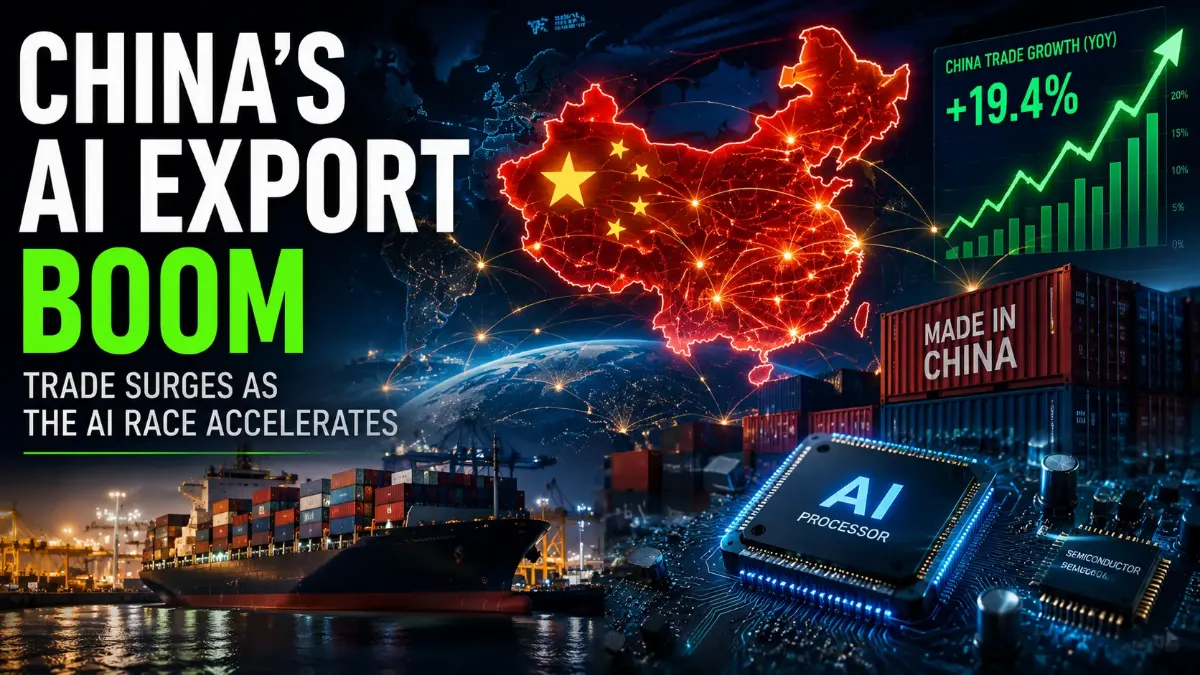
Recent trade data from China suggests that artificial intelligence is becoming a powerful force behind international commerce, driving demand for semiconductors, data-center equipment, advanced manufacturing tools, and technology infrastructure.
The AI boom is no longer limited to Silicon Valley.
It is increasingly shaping how goods move around the world.
China's Trade Surge Highlights A Bigger Trend
China's latest export and import figures surprised many economists.
Trade activity remained significantly stronger than expected despite ongoing concerns about the global economy.
While several factors contributed to the increase, one theme stood out.
Demand for AI-related products.
As companies worldwide invest billions into artificial intelligence infrastructure, demand for technology hardware continues to grow.
This includes:
- Advanced semiconductors
- Data-center equipment
- Networking hardware
- Cloud-computing infrastructure
- Industrial automation systems
These products form the foundation of the modern AI economy.
Why AI Requires Massive Physical Infrastructure
Many people think of artificial intelligence as software.
In reality, AI depends heavily on physical infrastructure.
Every AI model requires:
- Powerful processors
- Massive data centers
- Networking equipment
- Cooling systems
- Energy infrastructure
Building these systems creates enormous demand throughout global supply chains.
This is one reason the AI boom has become a major driver of international trade.
The scale of investment was explored in The $10 Trillion AI Race Between America and China.
Governments and corporations are spending unprecedented amounts to secure leadership in artificial intelligence.
Semiconductors Are Becoming The New Oil
For decades, oil was viewed as the world's most strategically important resource.
Today, semiconductors are increasingly being discussed in similar terms.
Without advanced chips:
- AI models cannot be trained
- Data centers cannot operate
- Cloud infrastructure cannot expand
This has turned semiconductor manufacturing into one of the most important industries in the global economy.
Countries around the world are competing to secure access to advanced chip technology.
The result is a growing race involving trade, industrial policy, and technological leadership.
AI Is Creating Winners Across Global Markets
The AI boom is producing benefits far beyond software companies.
Several industries are experiencing increased demand because of AI-related spending.
These include:
Semiconductor Manufacturers
Chipmakers remain at the center of AI development.
Data Center Operators
Growing AI workloads require enormous computing capacity.
Cloud Providers
Businesses continue moving AI applications into cloud environments.
Industrial Automation Companies
Manufacturers are increasingly adopting AI-powered systems.
Logistics And Infrastructure Firms
Global trade volumes increase as technology investment expands.
This broad impact helps explain why AI has become one of the most important themes in financial markets.
Investors Are Watching Closely
The AI trade story is becoming increasingly important for investors.
The reason is simple.
Technology spending is no longer limited to a handful of companies.
Entire industries are benefiting from AI-related investment.
This has helped fuel strong performance across technology markets.
However, questions remain about valuation and sustainability.
Those concerns were discussed in Is the AI Stock Boom Finally Running Out of Steam?.
The long-term opportunity may be enormous.
But investors continue debating whether current expectations are realistic.
The IPO Wave Could Add More Momentum
Another major development is the growing possibility of AI-related IPOs.
Reports surrounding OpenAI have intensified interest in future listings.
If major AI companies eventually enter public markets, investor attention could increase further.
This trend was explored in The $1 Trillion AI IPO Race Has Begun.
An IPO wave would likely attract additional capital into the sector while increasing public participation in AI-driven growth.
Why This Matters Beyond Technology
The impact of AI-driven trade extends far beyond technology companies.
It affects:
- Economic growth
- Manufacturing output
- Employment
- Energy demand
- Global supply chains
As AI infrastructure expands, these effects could become increasingly visible across the broader economy.
In many ways, artificial intelligence is beginning to resemble previous industrial revolutions.
The difference is speed.
The pace of investment is occurring much faster than previous technological transitions.
The Global Competition Is Intensifying
The race for AI leadership has become a strategic priority for major economies.
The United States continues investing heavily.
China continues expanding manufacturing capacity and technology exports.
Europe is attempting to strengthen domestic technology industries.
Governments increasingly view AI as both an economic and national-security priority.
This competition is likely to shape trade patterns for years to come.
Bottom Line
Artificial intelligence is no longer just transforming software.
It is reshaping global trade itself.
China's latest trade figures offer evidence that AI-driven demand is influencing exports, imports, manufacturing activity, and infrastructure investment.
The AI boom is creating new winners across industries and countries.
And as investment continues accelerating, artificial intelligence may become one of the most important drivers of global commerce throughout the remainder of the decade.