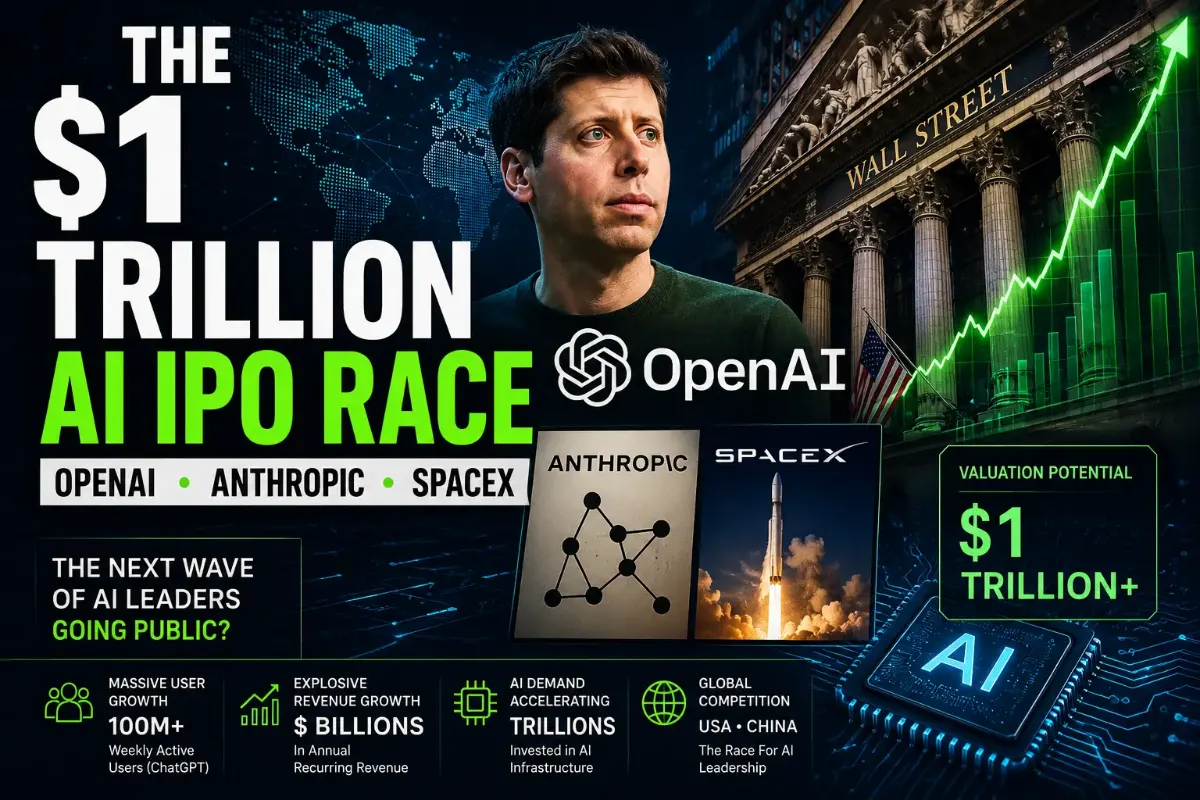
For the past two years, the artificial intelligence story has been dominated by one question:
Who will build the most powerful AI?
Now investors are asking a different question.
Who will be the first AI giant to conquer Wall Street?
Reports that OpenAI has confidentially filed paperwork for a potential public offering have intensified speculation that the next phase of the AI boom is about to begin.
If the reports prove accurate, the listing could become one of the largest and most closely watched technology IPOs in modern history.
More importantly, it could signal the start of a race involving OpenAI, Anthropic, SpaceX, and other technology leaders competing for public-market capital.
Why This IPO Matters
Most technology IPOs attract attention.
Few have the potential to reshape entire sectors.
OpenAI is different.
The company sits at the center of the global AI revolution.
Its products have transformed how businesses, students, developers, and consumers interact with technology.
The company's influence extends far beyond chatbots.
AI is now affecting:
- Software development
- Search engines
- Customer service
- Healthcare
- Finance
- Education
- Scientific research
An IPO would give investors direct exposure to one of the most influential technology companies of the decade.
The AI Boom Has Already Changed Markets
Artificial intelligence has become one of the strongest themes driving global financial markets.
Companies connected to AI infrastructure, cloud computing, semiconductors, and data centers have seen enormous investor demand.
The scale of investment is unprecedented.
Recent developments were explored in The $10 Trillion AI Race Between America and China, which highlighted the growing competition between governments and corporations seeking leadership in AI.
An OpenAI IPO would represent another major milestone in that race.
Why Wall Street Is Paying Attention
Investors are constantly searching for the next generation of market leaders.
Many of today's largest public companies emerged from previous technology revolutions.
Microsoft.
Amazon.
Google.
Meta.
Nvidia.
The AI industry is widely viewed as the next transformative platform.
A successful OpenAI listing could become a defining event for technology investors, much like Google's IPO in 2004 or Facebook's IPO in 2012.
For institutional investors, the opportunity extends beyond short-term excitement.
The real question is whether AI companies can generate sustainable profits that justify their massive valuations.
The Valuation Debate
Every major technology boom eventually reaches the same stage.
Investors stop asking whether the technology is important.
They start asking whether the price makes sense.
This debate is already underway.
Many AI-related stocks have delivered extraordinary gains over the last two years.
As a result, concerns about valuation have become more common.
Those concerns were discussed in Is the AI Stock Boom Finally Running Out of Steam?.
Supporters argue that AI could become one of the largest economic transformations in history.
Skeptics believe expectations may already be too optimistic.
An OpenAI IPO would likely become the most important test of investor sentiment toward the AI sector.
OpenAI Is Not Alone
While OpenAI receives most of the headlines, the competitive landscape is becoming increasingly crowded.
Anthropic has emerged as one of the strongest challengers in the AI industry.
Google continues investing heavily in artificial intelligence.
Meta is spending billions on AI infrastructure.
Microsoft remains deeply integrated into OpenAI's ecosystem.
Meanwhile, SpaceX has become another company frequently mentioned in discussions about future blockbuster IPOs.
Together, these companies represent some of the most sought-after private assets in the world.
What Investors Should Watch
The excitement surrounding a potential IPO should not distract investors from the fundamentals.
Several questions remain unanswered.
Revenue Growth
Can AI companies continue growing at current rates?
Profitability
Can AI businesses generate sustainable profits despite enormous computing costs?
Competition
How intense will competition become as more players enter the market?
Regulation
Governments around the world are still developing rules for artificial intelligence.
Future regulations could influence growth prospects.
Why The Timing Matters
The IPO discussion comes during a period of growing uncertainty in financial markets.
Investors are simultaneously dealing with:
- Inflation concerns
- Interest-rate uncertainty
- Geopolitical risks
- Slowing global growth
Recent market concerns were highlighted in Investors Are Starting to Question the Soft Landing Narrative.
Higher interest rates often make investors more selective about high-growth companies.
As a result, market conditions could play a major role in determining how future AI IPOs are received.
What It Means For Retail Investors
Many retail investors missed the early growth of private AI companies.
An IPO could provide broader access to one of the most important technology trends of the decade.
However, history shows that excitement alone does not guarantee strong investment returns.
Successful investing requires understanding:
- Valuation
- Growth potential
- Competition
- Risk
Investors should avoid treating any IPO as a guaranteed winner.
Even revolutionary companies can experience significant volatility after going public.
The Bigger Picture
The potential OpenAI IPO is about more than one company.
It represents the transition of artificial intelligence from a private-market phenomenon into a public-market investment theme.
The next few years could see:
- OpenAI IPO
- Anthropic IPO
- Additional AI listings
- Increased institutional investment
- Greater competition for AI leadership
This process could reshape technology investing for the next decade.
Bottom Line
The reported OpenAI IPO filing marks a potentially historic moment for financial markets.
Artificial intelligence is no longer just a technological story.
It has become one of the most important investment stories in the world.
Whether OpenAI ultimately goes public this year or later, one thing is becoming increasingly clear:
The race to dominate artificial intelligence is evolving into a race for investor capital.
And Wall Street wants a front-row seat.