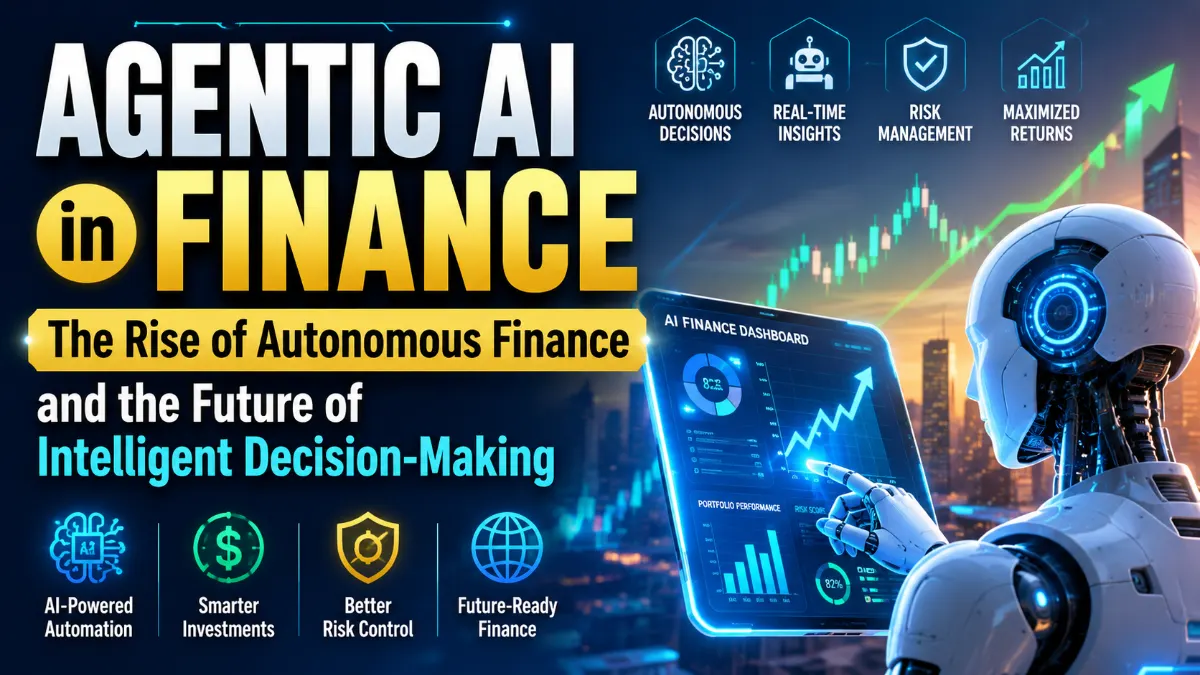
Introduction: Finance Is Entering Its Autonomous Era
For decades, financial institutions have invested billions of dollars in automation technologies designed to reduce manual work, increase efficiency, and improve accuracy. From spreadsheet macros and enterprise resource planning (ERP) systems to robotic process automation (RPA), each wave of innovation promised to make finance faster and more efficient.
Yet despite these advances, most financial operations still depended heavily on human supervision. Traditional automation could only follow predefined rules. If a process encountered an unexpected scenario, missing data point, or unusual transaction, it typically stopped and required human intervention.
That limitation is now being challenged by a new generation of artificial intelligence.
Agentic AI represents one of the most significant technological shifts the finance industry has experienced since the introduction of digital banking. Rather than merely assisting employees with individual tasks, agentic systems can reason, plan, execute, evaluate outcomes, and adapt their actions based on changing circumstances.
This evolution is giving rise to what many analysts call Autonomous Finance—an environment where intelligent software agents continuously monitor financial systems, make recommendations, coordinate workflows, and in some cases execute decisions with minimal human involvement.
According to Gartner, by 2030 more than 80% of finance functions are expected to embed AI-driven autonomy into their core operations. The implications extend far beyond efficiency gains. Agentic AI could fundamentally reshape accounting, lending, treasury management, compliance, auditing, wealth management, and corporate decision-making. The broader impact of AI on economic systems is already becoming visible across industries, as explored in How Artificial Intelligence Is Quietly Reshaping Global Trade
The transition is not simply about replacing repetitive tasks. It is about creating financial systems that can think, learn, and act
Why Businesses Are Investing in Agentic AI
The enthusiasm surrounding autonomous finance is supported by compelling economic evidence.
Several studies indicate that agentic systems can significantly improve productivity, accuracy, and operational efficiency.
Research involving financial professionals shows that intelligent AI assistants allow users to consume substantially more information while reducing overall task completion times.
In many cases:
Research consumption increased by approximately 60%.
Task completion times fell by roughly 30%.
User focus shifted toward higher-value analytical activities.
These productivity gains are particularly important because finance professionals increasingly face information overload.
Analysts, auditors, risk managers, and treasury teams must process enormous volumes of data daily.
Agentic systems act as force multipliers, allowing employees to focus on strategic thinking rather than routine administrative work. Similar productivity trends are emerging in independent work as AI-powered tools transform how professionals earn income and deliver services, a trend discussed in The Rise of AI-Powered Freelancing: How Digital Tools Are Reshaping Global Work
Studies from leading academic institutions have also suggested that generative AI can improve the performance of highly skilled knowledge workers by as much as 40%.
For finance departments operating under constant pressure to do more with less, such gains are highly attractive
Use Case 2: Autonomous Credit Risk Assessment
Commercial lending has traditionally required extensive manual review.
Analysts often spend days or weeks evaluating:
Financial statements
Cash-flow projections
Industry risks
Debt obligations
Market conditions
Agentic AI compresses this process significantly.
A lending workflow may begin when a business submits an application.
The agent automatically requests missing documents and gathers additional information from multiple sources.
Secondary agents may:
Parse audited statements
Analyze cash-flow trends
Review debt covenants
Assess sector-specific risks
Incorporate macroeconomic indicators
The result is a comprehensive credit profile generated in minutes rather than weeks. Faster and more accurate risk analysis could significantly influence lending, real estate financing, and investment decisions, areas closely connected to trends outlined in the Real Estate Guide 2026: Buying, Selling, and Investing
Importantly, the system provides not only a score but also an explanation of how that score was reached.
This transparency is essential for regulatory compliance and internal governance.
Use Case 3: Wealth Management and Liquidity Optimization
Wealth management represents another area undergoing significant transformation.
Historically, portfolio managers monitored client allocations and periodically recommended adjustments.
The process often depended on scheduled reviews.
Agentic systems operate continuously.
They track:
Market volatility
Interest-rate movements
Portfolio exposures
Liquidity positions
Risk tolerances
Investors increasingly rely on data-driven portfolio frameworks, including approaches such as theCore and Satellite Investing Strategy Used by the Ultra-Wealthy
, which combines long-term stability with tactical opportunities
When conditions change, the AI proactively evaluates alternatives
For example, if a portfolio becomes overly concentrated in a particular sector, the agent may:
Model downside risk scenarios
Simulate rebalancing options
Estimate tax implications
Generate compliance documentation
Present execution recommendations
The human advisor remains involved, but much of the analytical workload is automated.
This enables more responsive and personalized financial management.
Treasury Management in the Autonomous Era
Corporate treasury departments face increasingly complex challenges.
They must balance:
Liquidity
Funding requirements
Currency risks
Interest-rate exposure
Investment opportunities
Agentic AI provides continuous oversight of these variables.
Instead of relying on weekly or monthly reports, treasury agents monitor positions in real time.
When market conditions shift, they can:
Recommend hedging strategies
Reallocate cash reserves
Optimize funding sources
Forecast liquidity shortages
These capabilities become particularly valuable during periods of macroeconomic uncertainty, such as those discussed inThis proactive approach helps organizations make faster and more informed decisions
Data Quality Challenges
One often overlooked reality is that AI systems depend heavily on data quality.
Many organizations operate with fragmented systems, inconsistent records, and unstructured documents.
Industry research suggests that data preparation consumes the majority of implementation effort.
Invoices, contracts, emails, spreadsheets, and legacy databases must be transformed into structured formats before agents can operate effectively.
Without reliable data, even sophisticated AI systems can make poor decisions. Organizations seeking better financial visibility often begin by establishing accurate baseline metrics, including net worth and cash-flow tracking through tools like theNet Worth Calculator
The Future of Autonomous Finance
The next decade may witness one of the most profound transformations in financial history.
Finance departments are evolving from transaction-processing centers into intelligence-driven decision hubs.
As Agentic AI matures, organizations will increasingly deploy networks of specialized agents capable of managing complex workflows with minimal human intervention.
We can expect advancements in:
Real-time financial planning
Autonomous treasury operations
Intelligent compliance monitoring
Continuous auditing
Predictive risk management
Hyper-personalized wealth management
As intelligent systems become more integrated into investment workflows, they may also influence how individuals build diversified income streams and long-term wealth strategies, similar to concepts explored in 7 Income Streams of Millionaires: How Wealthy People Build Money That Works for Them However, the future is unlikely to be defined by machines replacing humans.
Instead, the most successful organizations will be those that effectively combine human expertise with machine intelligence