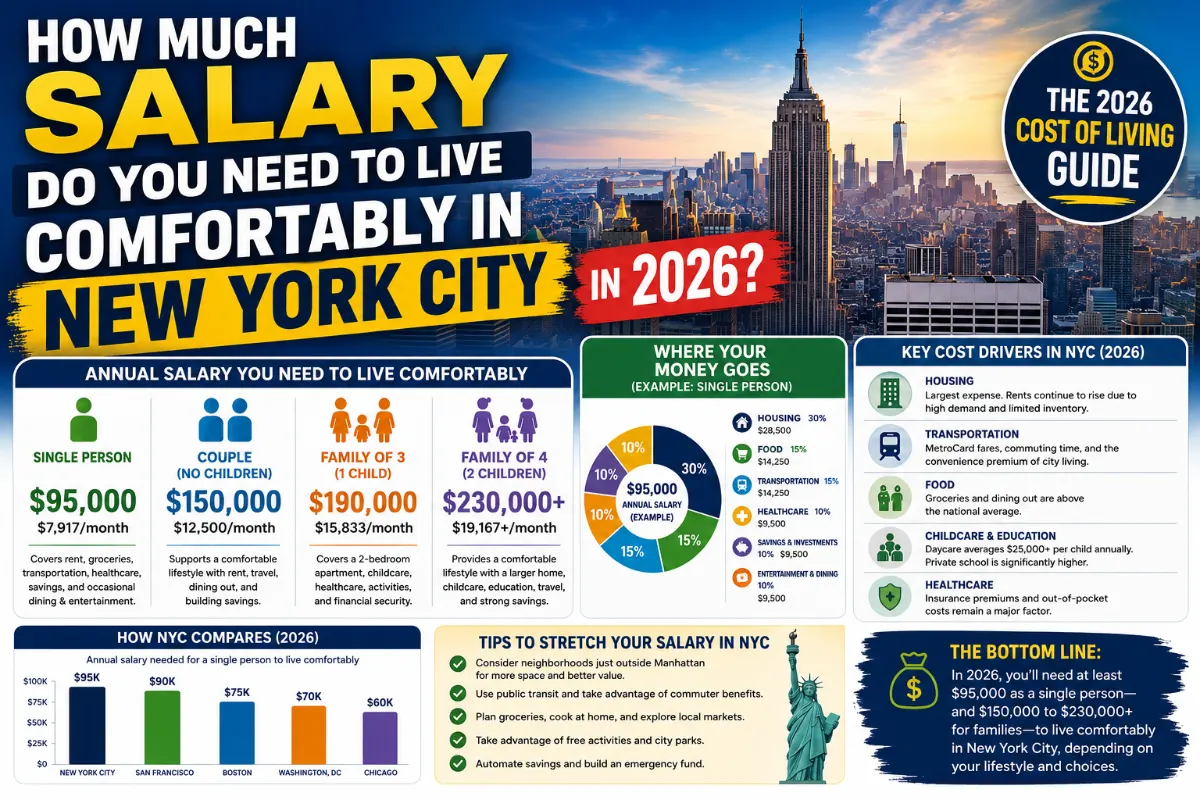
New York City has always carried a reputation for opportunity, ambition, and high salaries. It is home to some of the world's largest financial institutions, technology firms, media companies, and cultural landmarks. Yet alongside those opportunities comes a reality that every resident eventually encounters: New York is extraordinarily expensive.
For decades, people have asked the same question: "How much money do you actually need to live comfortably in New York City?"
In 2026, the answer is more eye-opening than ever.
Recent cost-of-living studies suggest that a single adult needs approximately $158,954 per year before taxes to maintain a genuinely comfortable lifestyle under the widely used 50/30/20 budgeting model. For a family of four with two working adults and two children, that number rises to nearly $338,000 annually.
These figures may seem shocking at first glance, but they reveal a broader story about housing affordability, wage growth, and the changing economics of urban living. For anyone considering a move, comparing expenses with a dedicated cost of living calculator
can provide a more personalized estimate of what life in New York may actually cost.
The Difference Between Surviving and Living Comfortably
One of the biggest misconceptions in personal finance is assuming that a "living wage" and a "comfortable salary" are the same thing.
They are not.
According to the MIT Living Wage Calculator, a single adult in New York State requires approximately $62,167 annually to meet basic needs without public assistance. This covers essentials such as housing, food, healthcare, transportation, and taxes.
A comfortable lifestyle, however, involves more than survival.
It means having enough income to:
Pay bills without constant financial stress
Build emergency savings
Invest for retirement
Enjoy entertainment and travel
Handle unexpected expenses
Maintain a reasonable quality of life
The gap between survival and comfort is where many New Yorkers find themselves struggling. Understanding the difference is similar to examining broader wealth benchmarks, such aswhat net worth qualifies as upper middle class in 2026.
Why Housing Dominates Every Budget
If there is one factor responsible for New York City's extraordinary cost of living, it is housing.
Rent consumes a larger share of income in New York than in most American cities, making it the single biggest obstacle to financial comfort.
For a one-bedroom apartment, monthly rent typically falls into the following ranges:
Manhattan: $3,800–$4,200
Brooklyn: $2,500–$3,200
Queens: $2,500–$3,000
The Bronx and Staten Island: Often below $2,500
For many residents, housing alone can consume 35% to 50% of take-home pay.
Economically speaking, this creates a phenomenon known as cost burden, where housing expenses grow faster than income. As rents increase, households have less money available for savings, investments, and discretionary spending.
This is one reason why individuals earning six-figure salaries can still feel financially stretched in New York. Similar affordability concerns are emerging internationally, as seen in our analysis of salary requirements for comfortable living in Toronto
The Hidden Costs Beyond Rent
While housing receives most of the attention, other expenses quietly add thousands of dollars to annual living costs.
Utilities and Internet
Electricity, gas, heating, cooling, and broadband services can add between $150 and $300 per month, depending on the season and building type.
Food and Groceries
A modest grocery budget typically ranges from $500 to $700 monthly for a single adult.
However, New York's dining culture often pushes spending much higher. Regular restaurant visits, takeout, and food delivery services can easily add several hundred dollars each month.
Transportation
One financial advantage New York offers is its extensive public transit network.
A monthly subway pass costs approximately $132, making transportation far cheaper than owning a vehicle in many other major cities.
Still, occasional rideshare trips and commuter rail travel can push transportation costs above $200 per month.
Healthcare
Even with employer-sponsored insurance, healthcare remains a significant expense.
Premiums, deductibles, prescriptions, and out-of-pocket medical costs often range between $250 and $500 monthly.
The Borough Effect: One City, Four Different Cost Structures
A common mistake is treating New York City as a single housing market.
In reality, where you live dramatically affects how much income you need.
Manhattan
Estimated monthly expenses often range from $6,000 to $7,500.
Living independently in Manhattan generally requires a salary of at least $140,000 or more simply to maintain financial stability.
Brooklyn
Brooklyn remains expensive but offers somewhat greater value.
Comfortable living typically requires annual earnings between $100,000 and $120,000.
Queens
Queens provides a more balanced cost-to-income equation.
Many residents can achieve a comfortable lifestyle with incomes between $90,000 and $110,000.
The Bronx and Staten Island
These boroughs offer the lowest overall costs within New York City.
A salary between $75,000 and $85,000 can often support a relatively comfortable lifestyle, particularly for individuals willing to accept longer commute times.
The Great Income Reality Gap
Perhaps the most fascinating economic insight is the gap between the salary required for comfort and the income most New Yorkers actually earn.
While financial studies suggest that comfort begins around $159,000 annually, the median household income across New York City generally falls between $81,000 and $88,000.
In other words, the typical household earns roughly half of what many financial models consider ideal.
So how do millions of New Yorkers make it work?
The answer lies in adaptation.
Many residents reduce costs through:
Living with roommates
Sharing apartments with family members
Choosing outer-borough neighborhoods
Forgoing car ownership
Delaying home purchases
Reducing retirement contributions
Limiting discretionary spending
New Yorkers have effectively created their own economic survival strategies to compensate for the city's affordability challenges. Many households also combat rising expenses by avoiding lifestyle inflation that quietly consumes income growth over time.
What These Numbers Tell Us About the Modern Economy
Beyond personal budgeting, New York's cost structure highlights several broader economic trends.
- High Salaries Do Not Always Mean High Wealth
A person earning $150,000 in New York may have less disposable income than someone earning $90,000 in a lower-cost city.
Income alone does not determine financial well-being. Long-term wealth accumulation ultimately depends on savings, investments, and asset growth, which can be tracked using a net worth calculator
- Housing Has Become the Defining Economic Variable
For many households, housing costs now drive financial outcomes more than taxes, transportation, or even healthcare.
- Geographic Arbitrage Is Growing
Remote work has allowed some professionals to earn New York-level salaries while living in lower-cost regions.
This trend has become one of the most significant economic shifts of the post-pandemic era. The movement has accelerated interest in international relocation, particularly among professionals exploring the best countries for digital nomads.
- Financial Comfort Is Increasingly Relative
What feels wealthy in one city may feel merely middle class in another.
The purchasing power of income matters just as much as the income itself. Broader economic forces, including inflation and energy prices, continue to influence household budgets, as discussed in why rising oil prices could become the biggest inflation threat of 2026.
Final Thoughts
Living comfortably in New York City has never been cheap, but in 2026 the financial threshold is higher than many people realize.
A single adult now needs roughly $158,954 annually to achieve the kind of balanced lifestyle promoted by traditional financial planning models. Meanwhile, the minimum income needed simply to cover basic necessities is closer to $62,167.
The difference between those two figures tells the real story of modern urban America.
New York remains a city of opportunity, but it is also a city where housing costs, inflation, and lifestyle expectations continue to push the definition of financial comfort further upward. For aspiring residents, professionals considering relocation, and policymakers alike, understanding that reality is essential to navigating the economics of America's most iconic city.