For many Americans, the idea of being in the "top 10%" sounds synonymous with being wealthy. However, the reality is more nuanced. Whether someone qualifies for the top 10% depends on what is being measured—individual earnings, household income, or accumulated wealth.
Recent economic data from the U.S. Census Bureau, the Federal Reserve, and IRS income distribution reports provide a clearer picture of where the thresholds stand in 2026. Understanding these benchmarks offers valuable insight into income inequality, wealth accumulation, and the changing economic landscape of the United States.
The Top 10% Income Threshold in America
The most important distinction is between household income and individual income.
Household Income: Approximately $251,000+
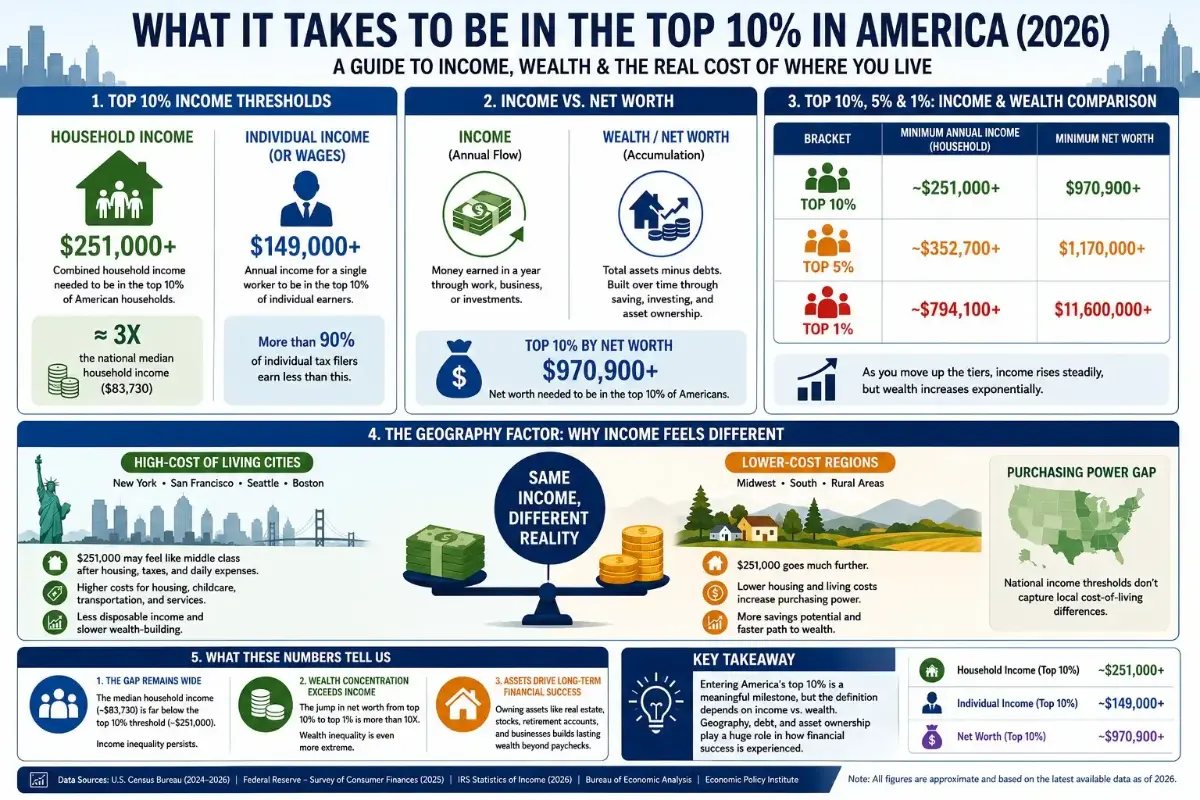
A household must earn roughly $251,000 per year to enter the top 10% of American households.
This figure reflects the combined earnings of everyone living in a household, which often includes dual-income professional couples. Compared to the national median household income of approximately $83,730, the top-10% threshold is nearly three times higher.
In practical terms, households reaching this level often include:
Senior corporate professionals
Successful small business owners
Physicians and medical specialists
Technology professionals in senior roles
Dual-income households with strong career earnings
Individual Income: Approximately $149,000+
For individual workers, the benchmark is significantly lower.
An individual must earn around $148,812 annually to reach the 90th percentile of income earners in the United States.
This means a single person earning roughly $149,000 per year makes more than 90% of individual tax filers nationwide.
Common occupations that frequently reach or exceed this threshold include:
Experienced software engineers
Attorneys
Financial professionals
Engineers in specialized fields
Mid-to-senior management professionals
Healthcare practitioners
Income Is Not the Same as Wealth
One of the most common misconceptions in economic discussions is treating income and wealth as interchangeable concepts.
Income represents the flow of money earned during a given year. Wealth, or net worth, represents the total value of assets after subtracting liabilities.
Someone earning a high salary may have limited wealth if they carry substantial debt, while another individual with moderate income may possess significant wealth through investments, real estate holdings, or inherited assets.
The Wealth Threshold for the Top 10%
According to Federal Reserve distribution data, an American household generally needs a net worth of approximately $970,900 to enter the top 10% by wealth.
Net worth includes:
Real estate equity
Retirement accounts
Stocks and investments
Business ownership stakes
Cash savings
Other assets minus all outstanding debts
This distinction highlights why high income alone does not automatically translate into financial security or long-term wealth.
How the Top 10% Compares to Higher Economic Tiers
As Americans move further up the economic ladder, the gap widens dramatically.
| Economic Tier | Minimum Household Income | Minimum Net Worth |
|---|---|---|
| Top 10% | ~$251,000 | ~$970,900 |
| Top 5% | ~$352,700 | ~$1.17 million |
| Top 1% | ~$794,100 | ~$11.6 million |
The table illustrates a key economic reality: income rises steadily across tiers, but wealth grows exponentially.
For example, moving from the top 10% to the top 1% requires household income to roughly triple. However, the required net worth increases more than tenfold.
This reflects the power of asset ownership, investment returns, and capital appreciation in generating long-term wealth.
The Geography Factor: Why Income Feels Different Across America
National statistics often fail to capture local economic realities.
A household earning $251,000 annually in a high-cost metropolitan area such as New York City, San Francisco, or Seattle may not experience a lifestyle commonly associated with wealth. Housing costs, childcare expenses, transportation, taxes, and everyday living expenses can consume a significant share of income.
In contrast, the same household income in lower-cost regions of the Midwest or South can provide:
Larger home ownership opportunities
Greater discretionary spending
Higher savings rates
Faster wealth accumulation
Economists often refer to this as the purchasing power gap. While income thresholds are measured nationally, living standards remain highly dependent on geography.
What These Numbers Tell Us About the Modern American Economy
Several broader economic trends emerge from these figures.
- The Gap Between Median and Top Earners Remains Significant
The median household income of approximately $83,730 remains far below the top-10% threshold of $251,000. This suggests that upper-income households continue to capture a disproportionate share of economic gains.
- Wealth Concentration Exceeds Income Concentration
Income inequality receives significant public attention, but wealth inequality is even more pronounced. The sharp jump from a top-10% net worth of roughly $971,000 to a top-1% net worth exceeding $11 million demonstrates the increasing concentration of assets.
- Asset Ownership Matters More Than Ever
Long-term financial success is increasingly driven by ownership of appreciating assets such as:
Equities
Retirement investments
Real estate
Businesses
While labor income remains important, wealth creation is often determined by investment growth over time.
Final Thoughts
Entering America's top 10% is a meaningful financial milestone, but the definition depends on whether we are discussing income or wealth.
In 2026:
A household generally needs about $251,000 in annual income to join the top 10%.
An individual earner typically needs around $149,000 annually.
A net worth of approximately $970,900 is required to rank among the wealthiest 10% of Americans.
Yet these figures tell only part of the story. Cost of living, asset ownership, debt levels, and regional economic conditions all influence how financial success is experienced in practice.
For economists, policymakers, and individuals alike, the lesson is clear: understanding prosperity requires looking beyond income alone and examining the broader relationship between earnings, wealth, and purchasing power.