For decades, retirement followed a predictable formula: work until your mid-60s, build a nest egg, and eventually leave the workforce.
The Financial Independence, Retire Early (FIRE) movement challenged that assumption.
Instead of asking, "When can I retire?" FIRE asks a different question:
"How much money do I need before work becomes optional?"
At its core, FIRE is about achieving enough financial independence that employment is no longer a necessity. Yet as the movement has evolved, two very different philosophies have emerged.
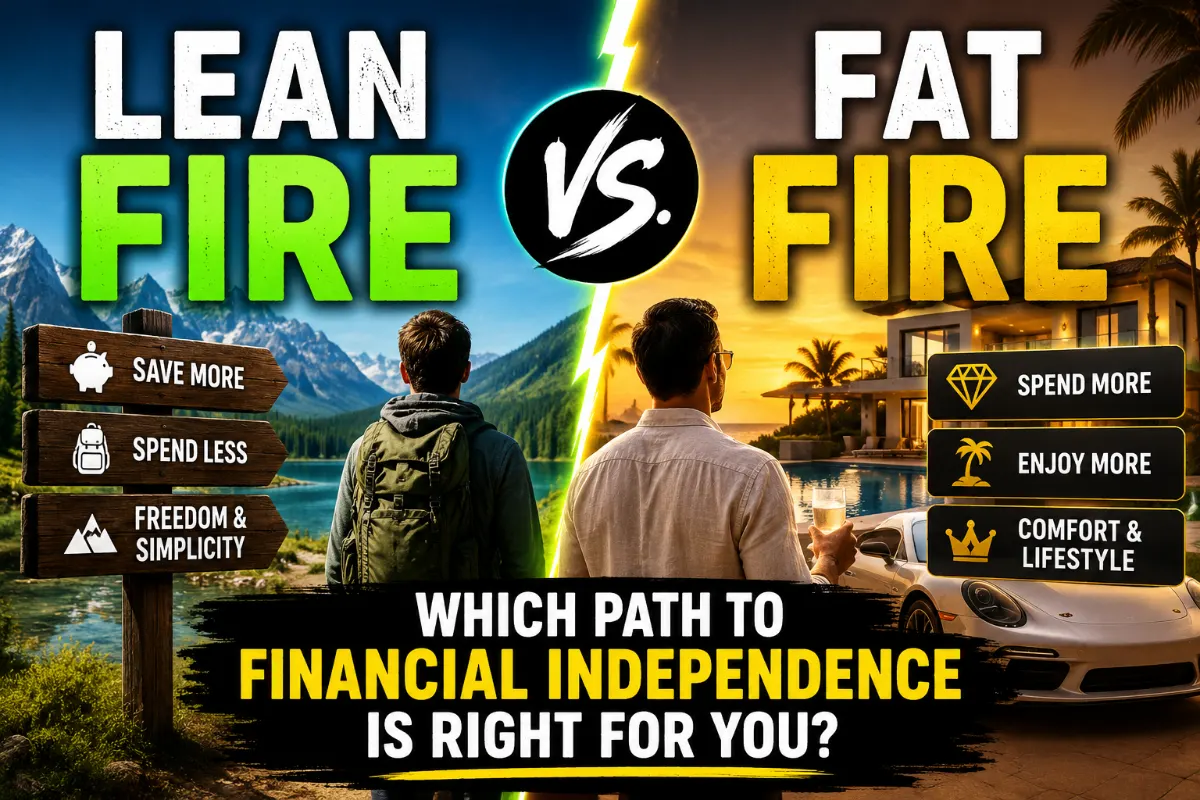
On one side is Lean FIRE, a minimalist approach focused on maximizing freedom through lower spending.
On the other is Fat FIRE, a strategy designed to support a comfortable—or even luxurious—lifestyle without financial constraints.
Both paths can lead to financial independence. The difference lies in how you want to live once you get there.
Understanding Your FIRE Number
Every FIRE plan begins with a simple concept: your FIRE Number.
This is the amount of invested assets required to generate enough income to cover your annual expenses indefinitely.
The formula is straightforward:
FIRE Number = Annual Expenses × Multiplier
The multiplier depends on your withdrawal strategy and risk tolerance.
Many early retirees now use a range of 28 to 35 times annual expenses, reflecting a more conservative approach to inflation, healthcare costs, and the possibility of a retirement lasting 40 or even 50 years.
The key takeaway is simple:
The less you spend, the lower your FIRE number.
The more lifestyle you want to maintain, the larger your portfolio must become. Investors can estimate where they currently stand by using a net worth calculator before setting long-term financial independence goals.
What Is Lean FIRE?
Lean FIRE is the minimalist version of financial independence.
Followers of this approach prioritize freedom and flexibility over material consumption. Their goal is not to become wealthy by traditional standards but to dramatically reduce the amount of money required to support their lifestyle.
A Lean FIRE lifestyle often includes:
Living in a low-cost city or rural area
Maintaining a modest home
Driving reliable used vehicles
Cooking most meals at home
Avoiding consumer debt
Emphasizing experiences over possessions
The focus is on intentional spending rather than deprivation.
Many Lean FIRE advocates argue that reducing expenses provides a faster path to independence than endlessly chasing higher income. This philosophy closely aligns with avoiding lifestyle inflation that quietly erodes long-term wealth.
The Lean FIRE Numbers
Most Lean FIRE households aim to spend approximately:
$40,000 to $55,000 per year
Using common FIRE withdrawal assumptions, this generally requires:
$1.1 million to $1.6 million invested
For example, a household spending $45,000 annually might target:
$1.26 million invested
This level of wealth is still substantial, but it is far more attainable than many traditional retirement projections.
For disciplined savers, Lean FIRE can often be achieved years—or even decades—earlier than conventional retirement.
The Advantages of Lean FIRE
From an economist's perspective, Lean FIRE benefits from one powerful mathematical advantage:
Lower expenses reduce the amount of capital required.
Every dollar removed from annual spending permanently lowers the size of the portfolio needed to sustain retirement.
This creates a double benefit:
You save more while working.
You need less money after retiring.
That combination dramatically accelerates the timeline to financial independence. Similar compounding principles explain how long it takes to save your first $100,000, a milestone often viewed as the foundation of wealth building.
The Risks of Lean FIRE
The primary challenge is resilience.
A tightly structured budget leaves less room for unexpected expenses.
Potential risks include:
Healthcare cost increases
Housing repairs
Inflation spikes
Family obligations
Long-term care expenses
When spending is already optimized to the minimum, unexpected costs can place pressure on a retirement portfolio.
As a result, Lean FIRE often requires greater flexibility and ongoing financial discipline.
What Is Fat FIRE?
If Lean FIRE focuses on minimizing expenses, Fat FIRE takes the opposite approach.
Fat FIRE seeks financial independence without sacrificing comfort, convenience, or lifestyle.
The philosophy is simple:
Build enough wealth that retirement feels abundant rather than restrictive.
Fat FIRE households often budget for:
Luxury travel
High-end housing
Premium healthcare
Frequent dining out
Private education
Household services
Expensive hobbies and recreation
The goal is not merely escaping work.
It is maintaining a high standard of living indefinitely.
The Fat FIRE Numbers
Most Fat FIRE plans assume annual spending of:
$150,000 to $250,000 or more
Using conservative retirement multipliers, that translates into portfolio targets of roughly:
$5 million to $7.5 million or more
For example:
A household planning to spend $180,000 annually may require nearly:
$6 million invested
This significantly increases the amount of wealth that must be accumulated before retirement becomes possible. Many households pursuing this path use wealth benchmarks such as what net worth qualifies as upper middle class in 2026 to measure progress.
The Advantages of Fat FIRE
The primary benefit of Fat FIRE is flexibility.
Larger portfolios create larger safety margins.
A high-net-worth retiree can typically absorb:
Market volatility
Healthcare inflation
Family emergencies
Lifestyle changes
without substantially altering spending habits.
In many cases, the biggest benefit is peace of mind.
A larger financial cushion often reduces retirement anxiety.
The Challenge of Fat FIRE
The downside is obvious.
It takes considerably longer to achieve.
Accumulating $6 million requires far more saving, investing, and income generation than accumulating $1.3 million.
Many Fat FIRE followers spend additional years in the workforce simply because the target is so much larger.
This creates a tradeoff between freedom today and comfort tomorrow. Wealthier FIRE followers often borrow concepts from the Core-and-Satellite investment strategy used by ultra-high-net-worth investors to balance growth and risk management.
The Middle Ground: Standard FIRE
Not everyone wants to live on a minimalist budget.
Likewise, not everyone needs a luxury lifestyle.
This has given rise to what many consider the middle path:
Standard FIRE.
Typically, this approach targets:
Annual spending of $80,000 to $100,000
Investable assets of roughly $2.5 million to $3.5 million
For many households, this level provides a comfortable middle-class lifestyle while still allowing for travel, hobbies, and family expenses.
It represents a balance between speed and security.
The Growing Popularity of Barista FIRE
Another increasingly popular variation is Barista FIRE.
Rather than retiring completely, individuals save enough to cover the majority of their expenses through investments while continuing to work part-time.
This income often covers discretionary spending such as:
Dining out
Travel
Entertainment
Healthcare premiums
The advantages are significant.
A small amount of earned income can dramatically reduce pressure on an investment portfolio, allowing retirees to leave stressful careers years earlier.
For many people, Barista FIRE offers the best of both worlds: financial freedom without complete workforce separation.
The rise of remote work and digital income streams has made this option increasingly practical, particularly as AI-powered freelancing reshapes the future of work
Which FIRE Strategy Is Right for You?
The answer has less to do with mathematics and more to do with personal values.
Lean FIRE is ideal for those who prioritize freedom and simplicity.
Fat FIRE appeals to individuals who value comfort, flexibility, and luxury.
Standard FIRE provides a balanced middle ground.
Barista FIRE offers a hybrid approach that reduces financial pressure while preserving lifestyle options.
None of these paths are inherently better than the others.
They simply represent different answers to the same question:
"What does an ideal life look like once money is no longer the primary constraint?"
The Bottom Line
The FIRE movement is often portrayed as a race to retire as early as possible.
In reality, it is a framework for designing a life around your priorities.
Lean FIRE demonstrates that financial independence can be achieved with surprisingly modest spending and a portfolio around $1 million to $1.5 million.
Fat FIRE proves that those seeking luxury and flexibility can also achieve early retirement—provided they accumulate the significantly larger portfolio required to support it.
Ultimately, the best FIRE strategy is not the one with the biggest number.
It is the one that aligns your finances with the lifestyle you genuinely want to live. Before choosing a path, it can be helpful to compare expected expenses using a cost of living calculator and build realistic assumptions into your retirement plan.
Because financial independence is not really about quitting work.
It is about gaining the freedom to choose how you spend your time.