# Asset Allocation for Beginners in 2026: How to Build a Balanced Portfolio
Building an investment portfolio is not simply about finding the “best” stock or fund. One of the most important decisions investors make is determining how their money is divided among different types of investments.
That process is called asset allocation.
For a beginner, asset allocation can sound complicated. In reality, the basic idea is straightforward: decide how much of your portfolio should be allocated to different asset classes based on your financial goals, investment time horizon, and ability to handle risk.
In 2026, investors have more choices than ever, from individual stocks and bonds to index funds, ETFs, target-date funds, cash products, and alternative investments. More choices can be useful, but they can also make portfolio construction confusing.
A simple asset-allocation framework can help investors focus on the bigger picture rather than constantly chasing individual investments.
What Is Asset Allocation?
Asset allocation is the process of dividing an investment portfolio among different asset classes.
The three major asset classes are generally:
- Stocks
- Bonds
- Cash and cash equivalents
Other categories, such as real estate, commodities, and private investments, can also be part of some portfolios.
The purpose is not necessarily to own everything. Instead, the goal is to create a combination of investments that fits your financial objective and risk tolerance.
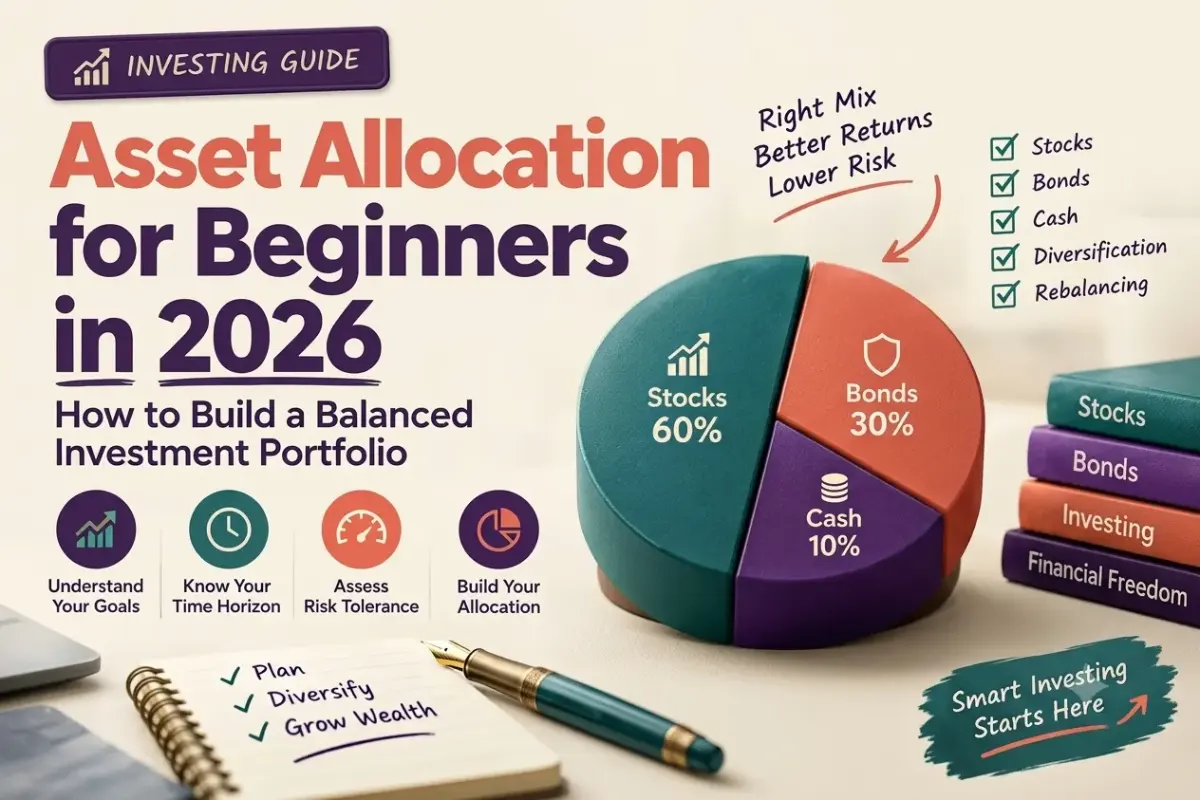
For example, a hypothetical portfolio could contain:
| Asset Class | Allocation |
|---|---|
| Stocks | 60% |
| Bonds | 30% |
| Cash | 10% |
This is only an illustration—not a recommendation for every investor.
There is no single asset allocation that is appropriate for everyone. The right mix depends on the individual investor and the goal being pursued.
Why Asset Allocation Matters
Different investments behave differently.
Stocks can provide substantial long-term growth potential, but they can also experience significant short-term price movements.
Bonds can provide income and may be less volatile than stocks, although they still carry risks.
Cash and cash equivalents are generally more stable but may provide lower long-term growth potential and can lose purchasing power when inflation is higher than the return earned.
By combining different asset classes, investors can create a portfolio that does not depend entirely on one type of investment.
The Securities and Exchange Commission's Investor.gov explains that the appropriate asset allocation depends significantly on an investor's time horizon and risk tolerance.
Asset Allocation vs. Diversification
These two concepts are related, but they are not identical.
Asset allocation
Asset allocation determines how much money goes into different asset classes.
For example:
- 70% stocks
- 20% bonds
- 10% cash
Diversification
Diversification means spreading investments across different investments so that the portfolio is not excessively dependent on one company, sector, asset, or market.
For example, owning 20 technology stocks is not necessarily a highly diversified portfolio simply because you own many stocks.
A diversified stock allocation could instead include exposure to different companies, industries, and geographic markets.
A portfolio can therefore have asset allocation without being sufficiently diversified.
The Three Main Asset Classes
1. Stocks
Stocks represent ownership in companies.
They generally provide greater long-term growth potential than cash, but they can also experience substantial volatility.
Stocks may make more sense for investors with longer time horizons who can tolerate temporary declines.
However, a stock-heavy portfolio can experience large losses during market downturns.
2. Bonds
Bonds are debt investments issued by governments, companies, and other entities.
Investors generally receive interest payments and repayment of principal according to the terms of the bond, although bond investments carry risks including credit risk, interest-rate risk, and market risk.
Bonds can play an important role in portfolios where an investor wants exposure to an asset class that may behave differently from stocks.
3. Cash and Cash Equivalents
Cash and cash-like investments can include savings deposits, certain money-market instruments, Treasury bills, and other short-term investments.
Cash is useful for short-term financial needs and liquidity.
However, keeping too much money in cash for long periods can create another risk: inflation can reduce the purchasing power of that money over time.
Your Time Horizon Should Influence Your Allocation
One of the most important questions to ask is:
When will I need this money?
Your investment time horizon is the period you expect to remain invested before you need the money for a particular goal.
Short-term goals
If you need the money relatively soon, taking substantial investment risk may be inappropriate because you may not have enough time to recover from a market decline.
For short-term goals, liquidity and capital preservation can become more important.
Medium-term goals
Medium-term goals require a balance between growth and stability.
The appropriate allocation depends on exactly when the money will be needed and how much volatility you can tolerate.
Long-term goals
Long-term goals generally give investors more time to withstand market fluctuations.
For a retirement goal that is decades away, for example, an investor may have more capacity to hold growth-oriented investments than someone who needs the money next year.
The important distinction is that long-term does not automatically mean aggressive. Risk tolerance and the specific goal still matter.
Risk Tolerance and Asset Allocation
Risk tolerance is another major factor.
Ask yourself:
> How would I react if my portfolio suddenly fell 20%?
Would you:
- Stay invested?
- Review your plan and continue?
- Become uncomfortable but remain invested?
- Sell everything because you are afraid of further losses?
Your answer can reveal how much volatility you may realistically tolerate.
There is also a difference between risk capacity and risk tolerance.
Someone may be emotionally comfortable with high volatility but still have a short-term financial goal that requires a more conservative approach.
Good portfolio construction considers both the financial situation and the investor's ability and willingness to take risk.
Example Asset Allocations for Beginners
There is no universally correct percentage, but hypothetical examples can help explain the concept.
Example A: Growth-oriented portfolio
| Asset | Example Allocation |
|---|---|
| Stocks | 80% |
| Bonds | 15% |
| Cash | 5% |
This hypothetical portfolio has a greater emphasis on stocks and therefore may experience greater volatility.
Example B: Balanced portfolio
| Asset | Example Allocation |
|---|---|
| Stocks | 60% |
| Bonds | 30% |
| Cash | 10% |
This example places a meaningful allocation in both growth-oriented and more defensive assets.
Example C: Conservative portfolio
| Asset | Example Allocation |
|---|---|
| Stocks | 40% |
| Bonds | 45% |
| Cash | 15% |
This hypothetical portfolio emphasizes bonds and cash more heavily.
These examples are educational illustrations, not personalized investment recommendations.
How Beginners Can Build an Asset Allocation
A simple process can make portfolio construction easier.
Step 1: Identify the financial goal
Ask what you are investing for.
It could be:
- Retirement
- Education
- A home
- Financial independence
- Long-term wealth building
- Another specific financial objective
Different goals can require different approaches.
Step 2: Determine your time horizon
Estimate how long the money can remain invested.
A portfolio for a goal 25 years away can potentially be structured differently from one needed in two years.
Step 3: Evaluate your risk tolerance
Think about both your emotional response to market volatility and your financial ability to withstand losses.
Step 4: Choose broad asset classes
Decide how much exposure you want to stocks, bonds, cash, and potentially other asset categories.
Step 5: Diversify within each allocation
Don't stop at the asset-class level.
For example, if stocks represent part of your portfolio, consider whether that stock allocation is spread appropriately rather than concentrated in a few companies.
Broad-market index funds and ETFs can be one way investors seek diversification, although investors should still examine what each fund actually owns.
Step 6: Review the portfolio periodically
Your portfolio can drift over time.
If stocks rise substantially while bonds remain relatively unchanged, the percentage of your portfolio invested in stocks can become much larger than your original target.
That's where rebalancing becomes relevant.
Asset Allocation and Index Funds
Asset allocation does not require investors to select individual stocks and bonds.
Many investors use diversified index funds or ETFs to obtain exposure to broad markets.
For example, an investor might use:
- A broad stock-market index fund for the stock allocation
- A diversified bond fund for the bond allocation
- Cash or short-term instruments for the liquidity portion
The important point is to understand the fund's holdings rather than assuming that every fund automatically provides diversification.
A narrowly focused fund can still leave an investor concentrated in a particular industry, theme, company group, or geographic market.
Asset Allocation and Portfolio Rebalancing
Asset allocation establishes your target.
Rebalancing helps you return toward that target when the portfolio drifts.
For example, suppose your original target is:
- 60% stocks
- 30% bonds
- 10% cash
After a strong stock-market period, your portfolio could potentially become:
- 75% stocks
- 20% bonds
- 5% cash
Your portfolio is now taking a different level of risk than it originally did.
Rebalancing may involve selling some overweight assets, buying underweight assets, or directing new contributions toward the underweight portion.
Investors should consider transaction costs and possible tax consequences before making changes.
How Often Should You Rebalance?
There is no universal answer.
Some investors use a calendar approach and review their allocation every six or twelve months.
Others use a threshold approach, where they review the portfolio after an asset class moves a predetermined amount away from its target.
The key is consistency.
Rebalancing too frequently can encourage unnecessary trading and make investors react to normal market movements.
For a deeper explanation, see Virearn's guide on how to rebalance an investment portfolio.
Common Asset Allocation Mistakes
Mistake 1: Copying someone else's portfolio
A portfolio that works for another investor may not fit your goals, time horizon, or risk tolerance.
Mistake 2: Chasing recent winners
An asset class that performed extremely well recently may attract investors after the biggest gains have already occurred.
Past performance does not guarantee future results.
Mistake 3: Keeping everything in cash
Cash can be useful for liquidity and short-term goals, but excessive cash holdings may reduce long-term growth potential and expose purchasing power to inflation.
Mistake 4: Taking too much risk
A portfolio may look attractive during a bull market but become difficult to maintain during a major decline.
A strategy you cannot stick with may be less useful than a slightly less aggressive strategy you can maintain.
Mistake 5: Confusing diversification with owning many investments
Owning dozens of funds does not automatically mean you are diversified.
Several funds can have substantial overlap in their holdings.
Mistake 6: Constantly changing the allocation
Changing your strategy every time markets move can turn a long-term investment plan into a series of emotional decisions.
A written investment plan can help reduce this behavior.
A Simple Asset Allocation Checklist
Before investing, ask:
- What is my financial goal?
- When will I need the money?
- How much investment risk can I financially handle?
- How much volatility can I emotionally tolerate?
- What percentage should be allocated to stocks?
- What percentage should be allocated to bonds?
- How much should remain in cash or cash equivalents?
- Are my investments diversified within each asset class?
- When will I review my allocation?
- What rules will I use for rebalancing?
Writing down the answers can make your investment strategy easier to follow.
Should Beginners Use a Target-Date Fund?
Some investors prefer a simpler approach.
Target-date funds are designed around a future date, such as a retirement year, and generally adjust their asset allocation over time as the target date approaches.
This can simplify portfolio management because the fund handles allocation and rebalancing internally.
However, investors should still review the fund's strategy, fees, holdings, and risk level before investing.
Final Thoughts
Asset allocation is one of the foundations of long-term portfolio construction.
Instead of trying to predict which investment will perform best next, investors can start by asking a more important question:
What combination of investments is appropriate for my goals and risk tolerance?
A thoughtful asset allocation can help investors organize their portfolios around their time horizon, diversification needs, and ability to handle market volatility.
The process does not end after the initial allocation. Financial goals, income, time horizons, and risk tolerance can change, while market movements can cause a portfolio to drift away from its intended structure.
The goal is therefore not to find a perfect allocation once and forget about it.
The goal is to create a sensible framework, diversify appropriately, review it periodically, and make changes when your financial circumstances or investment plan genuinely require them.