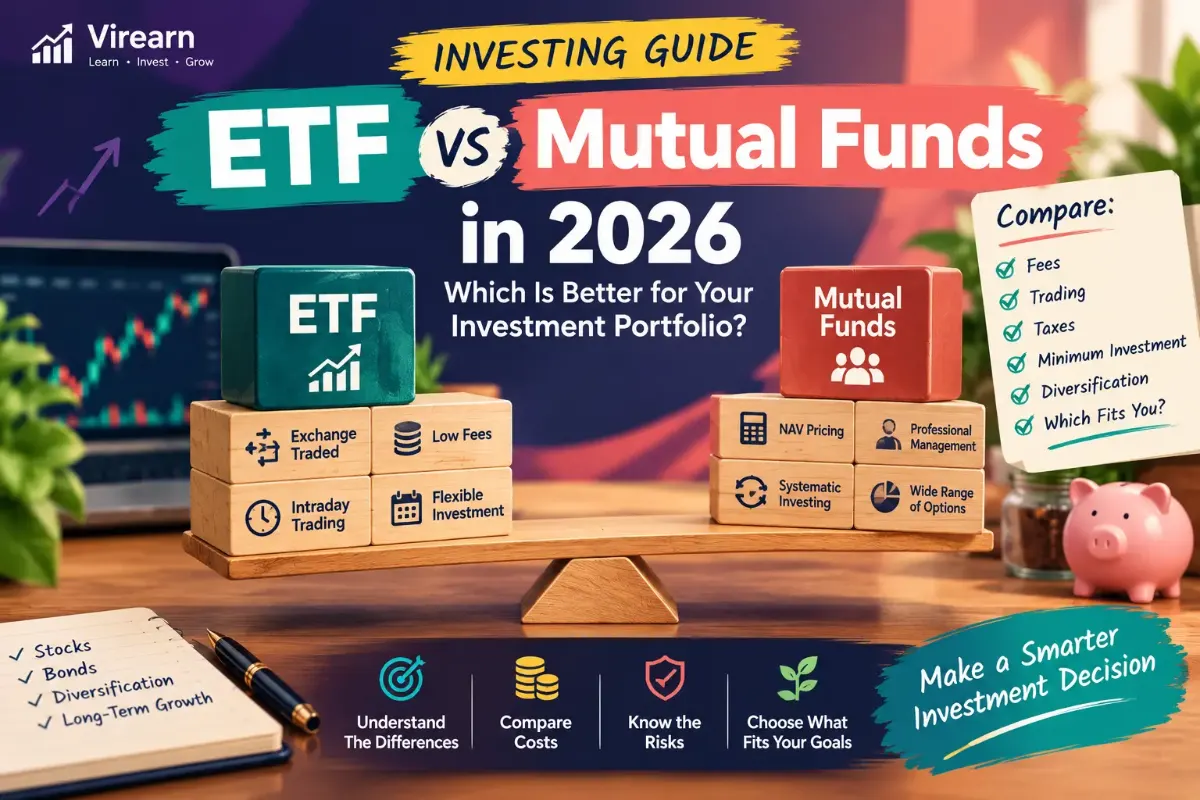
# ETF vs Mutual Funds in 2026: Which Is Better for Your Investment Portfolio?
For investors building a long-term portfolio, choosing the right investment vehicle can be almost as important as choosing what the portfolio invests in.
Two of the most common choices are exchange-traded funds (ETFs) and mutual funds.
Both can give investors exposure to a collection of stocks, bonds, or other investments. Both can be actively managed or designed to track an index. And both can play an important role in a diversified portfolio.
So what is the difference between an ETF and a mutual fund?
The biggest differences involve how they trade, how they are priced, fees, minimum investments, tax considerations, and how investors buy and sell them.
This guide explains the differences in simple terms and helps you understand when an ETF or mutual fund may make more sense for a particular investment approach.
What Is an ETF?
An exchange-traded fund, or ETF, is an investment fund that holds a collection of securities and trades on a stock exchange.
An ETF might hold:
- Stocks
- Bonds
- Commodities
- International securities
- Real estate-related investments
- A combination of assets
For example, a broad-market ETF may hold shares of hundreds or even thousands of companies.
Instead of purchasing every company individually, an investor can buy shares of the ETF and gain exposure to the fund's underlying portfolio.
ETFs can be actively managed or passively managed.
Many popular ETFs are designed to track an index.
What Is a Mutual Fund?
A mutual fund is also a pooled investment vehicle.
Investors contribute money to the fund, and the fund invests that money according to its stated strategy.
A mutual fund may invest in:
- Stocks
- Bonds
- Short-term securities
- International markets
- Sector-specific investments
- A combination of assets
Like ETFs, mutual funds can be actively managed or designed to track an index.
The major difference is that mutual fund shares are generally purchased and redeemed directly through the fund company or an intermediary rather than traded continuously on an exchange throughout the trading day.
ETF vs Mutual Funds: The Key Differences
| Feature | ETFs | Mutual Funds |
|---|---|---|
| Trading | Exchange-traded | Generally bought/redeemed through fund provider |
| Intraday trading | Yes | Generally no |
| Pricing | Market price during trading | Typically calculated at end-of-day NAV |
| Management | Passive or active | Passive or active |
| Diversification | Can provide broad diversification | Can provide broad diversification |
| Minimum investment | Often relatively flexible | May have minimum investment depending on fund |
| Expense ratios | Vary by fund | Vary by fund |
| Automatic investing | Available with many brokers | Commonly supported |
| Tax considerations | Depends on fund and account | Depends on fund and account |
| Best use | Flexible long-term or tactical investing | Long-term investing and automated contributions |
The exact features vary between individual funds and providers.
How ETFs and Mutual Funds Are Priced
One of the clearest differences is how investors purchase and sell shares.
ETFs
ETFs trade throughout the stock-market trading day.
Their market prices can change throughout the day based on supply, demand, and movements in the underlying securities.
An investor can generally place different types of orders depending on the brokerage platform.
Mutual funds
Mutual funds generally transact at their net asset value (NAV), which is calculated according to the fund's rules, typically at the end of the trading day.
This means you generally don't watch a mutual fund's price moving tick-by-tick throughout the trading session in the same way you might with an ETF.
ETF vs Mutual Fund Fees
Fees matter because investment costs can compound over long periods.
Both ETFs and mutual funds can have:
- Expense ratios
- Transaction-related costs
- Management expenses
- Other fund-level expenses
Some funds may have additional charges depending on their structure and provider.
An investor should not assume that ETFs are always cheaper or that mutual funds are always more expensive.
Instead, compare the actual expense ratio and other costs of the specific funds.
Even a small difference in annual costs can become meaningful over decades of investing.
Active Funds vs Passive Funds
Another important point is that ETF vs mutual fund is not the same comparison as active vs passive investing.
An ETF can be actively managed.
A mutual fund can be passively managed.
For example, two funds could both attempt to track the same broad stock-market index while one is structured as an ETF and the other as a mutual fund.
The investment strategy and fund structure are separate questions.
ETF vs Index Fund: Are They the Same?
This is a common source of confusion.
An index fund is a fund designed to track a particular market index or benchmark.
An ETF describes how a fund is structured and traded.
Therefore:
An ETF can be an index fund.
A mutual fund can also be an index fund.
For example, investors can find both ETF and mutual-fund versions of funds designed to track broad market indexes.
This is why comparing ETFs and mutual funds should involve more than simply asking which one is “better.”
Diversification
Both ETFs and mutual funds can make diversification easier.
Instead of purchasing dozens or hundreds of securities individually, an investor can potentially buy one diversified fund.
However, not every fund is highly diversified.
A fund could focus on:
- One industry
- One country
- A specific market segment
- A small group of companies
- A particular investment theme
Therefore, always check what a fund actually owns.
Owning several funds does not automatically mean you have a diversified portfolio if the funds hold many of the same securities.
Minimum Investment
Minimum investment requirements vary by fund.
Some ETFs can be purchased for the price of a single share, although the ability to purchase fractional shares depends on the brokerage.
Mutual funds may have minimum initial investment requirements, although many funds have relatively accessible options.
Investors should check the specific fund rather than assuming one structure always has a lower minimum.
Automatic Investing
Mutual funds have historically been popular for systematic investing because investors can set up recurring contributions directly into a fund.
ETFs can also be used for recurring investment strategies through many modern brokerage platforms.
For investors following a dollar-cost averaging strategy, the key question is not simply ETF versus mutual fund.
It is whether the chosen platform and fund allow the investor to make regular contributions conveniently and at a reasonable cost.
Tax Considerations
Taxes can be an important part of the ETF-versus-mutual-fund decision.
The tax treatment depends on factors including:
- The country where you live
- The account type
- The securities held by the fund
- Distributions
- Capital gains
- How and when the investment is sold
Some ETF structures can have tax-efficiency advantages in certain taxable-account situations, but investors should not assume that every ETF is automatically more tax-efficient than every mutual fund.
Tax rules can also change.
Investors should consider the applicable rules in their jurisdiction and seek professional tax advice when necessary.
Which Is Better for Long-Term Investors?
There is no universal winner.
A long-term investor could potentially build a successful portfolio using ETFs, mutual funds, or a combination of both.
The more important questions are:
- What does the fund invest in?
- What does it cost?
- How diversified is it?
- Does it fit the investor's goals?
- Is the risk appropriate?
- Can the investor consistently contribute?
- Is the investor likely to hold it through market cycles?
A low-cost, diversified fund that an investor understands and can hold consistently may be more useful than constantly switching between products.
When ETFs May Be Attractive
ETFs may be particularly appealing to investors who value:
Intraday trading
ETFs can be bought and sold throughout the trading day.
Flexible order types
Depending on the brokerage, investors can use different order types when trading ETFs.
Low-cost broad-market exposure
Many ETFs provide diversified exposure with relatively low expense ratios.
Portfolio flexibility
ETFs can make it easy to adjust allocations between different market segments.
However, flexibility can also encourage unnecessary trading.
For a long-term investor, the ability to trade throughout the day is not automatically an advantage if it leads to emotional decisions.
When Mutual Funds May Be Attractive
Mutual funds may appeal to investors who prefer:
Simple recurring investments
Many mutual-fund platforms support systematic contributions.
Professional management
Actively managed mutual funds can employ professional portfolio managers.
Long-term simplicity
Some investors prefer buying a fund and contributing regularly without worrying about intraday prices.
Retirement and institutional investing
Mutual funds remain widely used in long-term investment and retirement-oriented portfolios.
Again, the specific fund matters more than the label.
Example: Two Similar Portfolios
Imagine two investors want broad exposure to the same general stock market.
Investor A purchases a diversified ETF.
Investor B purchases a mutual fund that tracks a similar index.
Their underlying market exposure may be very similar.
The important differences may instead come from:
- Expense ratio
- Trading method
- Minimum investment
- Tax considerations
- Automatic investment options
- Fund provider
- Tracking performance
- Brokerage costs
This illustrates why investors should compare the actual products rather than simply choosing “ETF” or “mutual fund.”
ETF vs Mutual Funds for Beginners
For a beginner, the decision can be simplified.
Start by identifying the investment goal.
Then decide what type of exposure you need.
For example:
Goal → Asset allocation → Diversified fund → ETF or mutual fund → Regular contributions → Periodic review
This approach keeps the focus on the portfolio rather than the product label.
If you are investing for long-term wealth building, the ability to remain disciplined may matter more than small differences between two otherwise similar funds.
Common Mistakes to Avoid
1. Choosing solely based on past performance
A fund that performed exceptionally well recently may not continue to outperform.
2. Ignoring fees
Investment costs can reduce long-term returns.
3. Buying too many overlapping funds
Five funds can sometimes contain many of the same companies.
4. Trading ETFs too frequently
The fact that ETFs trade throughout the day does not mean investors should constantly buy and sell them.
5. Assuming every ETF is diversified
Some ETFs are highly concentrated or focused on specific themes.
6. Ignoring taxes
Tax consequences can affect the actual return an investor keeps.
7. Choosing a fund without reading its objective
Always understand what the fund is designed to do before investing.
A Simple ETF vs Mutual Fund Checklist
Before selecting a fund, compare:
- Investment objective
- Underlying holdings
- Diversification
- Expense ratio
- Historical tracking
- Minimum investment
- Trading costs
- Automatic investment options
- Tax considerations
- Liquidity
- Risk level
- Your own investment goal
This checklist can help prevent investors from choosing a fund simply because it is popular.
How ETFs and Mutual Funds Fit Into a Portfolio
The fund itself is only one part of portfolio construction.
Your overall asset allocation might include:
- Stocks
- Bonds
- Cash
- Other investments appropriate to your strategy
An ETF could represent your stock allocation.
A mutual fund could represent your bond allocation.
Or you could use mutual funds for both.
There is no requirement that an investor use only one fund structure.
Your overall portfolio should be evaluated as a complete system rather than as a collection of unrelated products.
Final Verdict: ETF or Mutual Fund?
For most investors, the answer is:
It depends.
ETFs can offer flexibility, intraday trading, and access to many low-cost diversified strategies.
Mutual funds can offer simplicity, systematic investing, and a wide range of active and passive strategies.
Neither structure automatically produces better investment returns.
The more important factors are what the fund owns, how much it costs, how diversified it is, how it fits your asset allocation, and whether you can stick with your investment strategy over the long term.
For beginners, starting with a simple, diversified approach can be more important than trying to find the perfect investment product.
Once your basic portfolio is established, you can review it periodically and rebalance when necessary.