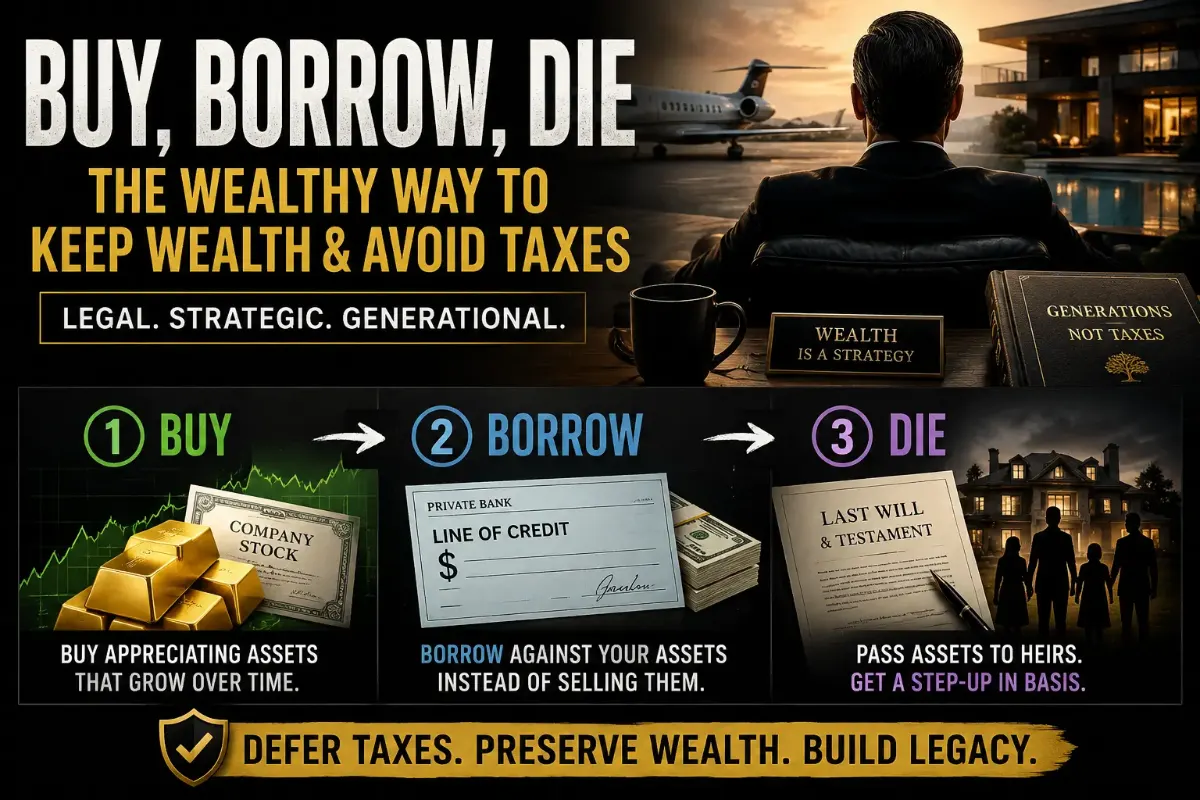
Imagine becoming enormously wealthy without selling the assets that made you rich.
Your stocks rise.
Your business becomes more valuable.
Your real estate appreciates.
On paper, your wealth increases by millions of dollars.
But instead of selling those assets and creating a potentially large tax bill, you borrow against them.
You get cash.
You continue owning the assets.
And, under current U.S. tax rules, borrowing money generally isn't the same thing as earning taxable income because you have an obligation to repay it.
This is the basic idea behind a wealth strategy commonly called:
Buy, Borrow, Die.
The name sounds like something invented for social media.
The underlying concepts are very real.
And they reveal one of the biggest differences between how ordinary workers and extremely wealthy asset owners can experience the tax system.
First: This Isn't a Magic Tax Loophole
Let's clear something up.
Buy, Borrow, Die doesn't mean billionaires can simply withdraw unlimited money without consequences.
Loans have interest.
Lenders require collateral.
Asset prices can crash.
Tax laws can change.
Estates can owe taxes.
And borrowing too aggressively can destroy wealth surprisingly quickly.
But for someone who owns a huge portfolio of appreciating assets, the strategy can create an advantage that a salaried worker usually doesn't have.
To understand why, we need to start with one simple distinction.
Income and Wealth Aren't the Same Thing
Suppose you earn a $100,000 salary.
You receive income.
That income is generally subject to applicable taxes.
Now imagine you own $10 million of stock.
During the year, its value rises to $12 million.
You became $2 million wealthier.
But you didn't necessarily receive $2 million in cash.
That increase is generally an unrealized gain.
Under the U.S. system, appreciation in an asset generally isn't taxed as a capital gain merely because its market value increased.
Usually, the taxable event arrives when the gain is realized—for example, when the asset is sold.
That distinction is enormously important.
For a deeper breakdown of how realized gains and tax basis work, read Capital Gains Taxes in 2026.
Step 1: Buy
Imagine an entrepreneur owns shares worth $10 million.
Over many years, those shares appreciate to $50 million.
If the owner sells a large portion of the shares, that sale can realize a substantial capital gain.
So instead, they keep the shares.
The wealth remains invested.
The assets may continue appreciating.
This is the Buy part.
It sounds almost too simple.
That's because the interesting part comes next.
This focus on long-term ownership is also a major part of how wealthy households structure portfolios. Virearn's guide on How the Ultra-Wealthy Invest explores that in more detail.
Step 2: Borrow
Our hypothetical investor now owns $50 million in stock but wants $1 million to fund their lifestyle or another investment.
They could sell $1 million of stock.
Or they could approach a lender and say:
I have $50 million of assets. Lend me $1 million against them.
This is commonly called securities-backed lending.
The portfolio acts as collateral.
The investor receives cash.
But they haven't necessarily sold the underlying stock.
And loan proceeds generally aren't treated as taxable income simply because the borrower received cash—the borrower also acquired an obligation to repay the money.
That's the mechanism that makes the strategy so interesting.
The rise of lending outside traditional banks is also reshaping how large borrowers access capital. Our Private Credit Crisis 2026 guide explains that broader shift.
A Simple Example
Consider two hypothetical investors.
Both own $20 million in appreciated stock.
Both want $500,000.
Investor A sells stock
Investor A sells $500,000 of shares.
Depending on their cost basis and circumstances, some of that sale may represent a taxable capital gain.
They also permanently give up ownership of the shares they sold.
Investor B borrows
Investor B uses the portfolio as collateral for a $500,000 loan.
They receive $500,000 in cash.
They still own the shares.
They owe $500,000 plus interest to the lender.
The second investor hasn't discovered free money.
They've exchanged tax and sale consequences today for debt and financial risk.
That's an important distinction.
Why Would a Bank Agree to This?
Because wealthy borrowers can offer extremely valuable collateral.
If someone owns a diversified $100 million portfolio and wants a relatively modest loan, a lender may view the transaction very differently from an unsecured personal loan.
The lender can structure the agreement around the collateral.
This can sometimes give wealthy borrowers access to credit on terms ordinary consumers can't obtain.
And that creates one of the stranger realities of modern finance:
Having enormous amounts of money can make borrowing money cheaper.
Why Not Just Keep Borrowing Forever?
Because eventually debt becomes dangerous.
Suppose you own $10 million in stock and borrow $1 million.
That's relatively conservative.
Now suppose you borrow $7 million.
Then the stock market falls 40%.
Your collateral is suddenly worth only $6 million.
You still owe the lender money.
Depending on the loan agreement, the lender could require additional collateral or repayment.
If you can't provide it, assets may have to be sold.
Possibly at exactly the worst moment.
This is why borrowing against investments isn't a cheat code.
Leverage magnifies mistakes.
The Part That Makes the Strategy Famous: Die
Now we reach the controversial part.
Suppose someone purchased an asset decades ago for $1 million.
At death, it's worth $20 million.
That's a $19 million unrealized gain.
Under current U.S. tax rules, inherited property generally receives a basis related to its fair market value at the owner's death, subject to important exceptions and estate-specific rules.
This is commonly called the step-up in basis.
Imagine the heir inherits the asset with a basis of approximately $20 million.
If the heir subsequently sells it for roughly $20 million, there may be little capital gain attributable to the appreciation that occurred during the original owner's lifetime.
That is the Die part of Buy, Borrow, Die.
The original owner:
bought the asset → held it while it appreciated → borrowed against it instead of selling → eventually passed it to heirs.
The mechanics can dramatically change when and how taxes arise.
This links directly to the broader transfer of wealth between generations covered in The Great Wealth Transfer.
Does That Mean No Tax Is Ever Paid?
No.
This is where viral explanations often become misleading.
Large estates may face federal estate tax.
State taxes can apply.
Different assets receive different treatment.
Trust structures can complicate things enormously.
Interest still has to be paid on loans.
Debts generally have to be dealt with by the estate.
And Congress can change tax law.
So Buy, Borrow, Die isn't:
"Become rich and legally pay zero tax forever."
It's better understood as a combination of existing rules involving:
- unrealized capital gains
- collateralized borrowing
- capital-gains realization
- inheritance
- cost basis
- estate planning
The combination can be extraordinarily powerful for the right person.
Large families often coordinate these decisions through dedicated structures, which is why Family Offices Explained is a useful next read.
Why This Works Better for Billionaires
Here's the uncomfortable part.
Imagine you earn $60,000 annually.
Most of your economic resources arrive as salary.
You can't simply decide that your employer should give you the $60,000 as a loan secured against $5 billion of stock.
You don't own $5 billion of stock.
Extremely wealthy people often receive much more of their economic growth through asset appreciation.
Their company shares rise.
Their private businesses become more valuable.
Their property appreciates.
Their investment portfolios compound.
That means a larger portion of their wealth can grow without being immediately converted into taxable salary.
It's one reason comparing someone's net-worth increase directly with their income-tax bill can be misleading.
They're different measurements.
If you're curious about where you stand financially, Virearn's [[calculator:net-worth]] helps separate assets, liabilities and actual net worth.
The Tax Code Often Rewards Ownership
This is the bigger lesson.
Most people think about getting richer primarily through income:
Work → earn salary → save → invest.
Very wealthy households often operate differently:
Own → appreciate → borrow → reinvest → transfer.
That doesn't mean working for a salary is bad.
It means ownership creates financial options that wages alone don't.
A business can appreciate.
Stocks can compound.
Property can rise in value.
And appreciating assets can sometimes become collateral.
This is one reason asset ownership plays such a large role in long-term wealth creation.
Our guide on 7 Income Streams of Millionaires explores other ways wealthy households can receive income beyond a paycheck.
Could a Normal Investor Use Buy, Borrow, Die?
Technically, parts of the strategy aren't exclusive to billionaires.
Investors can borrow against certain investment accounts or property.
But that doesn't mean they should.
The mathematics change dramatically depending on:
- portfolio size
- interest rate
- loan-to-value ratio
- asset volatility
- tax bracket
- investment horizon
- cash flow
Someone with $100 million borrowing $1 million is in a completely different position from someone with $100,000 borrowing $70,000.
The same financial tool can be conservative for one person and reckless for another.
Borrowing Against Stocks Can Go Very Wrong
Suppose you have:
Portfolio: $500,000
Loan: $200,000
Then your investments fall 50%.
Your portfolio is worth $250,000.
But the $200,000 debt hasn't fallen with it.
Your equity has collapsed from $500,000 before considering the debt to only $50,000 after subtracting it.
And that ignores interest.
This is why wealthy investors often keep borrowing relatively small compared with their overall assets.
Debt doesn't become safe merely because rich people use it.
What About Borrowing Against Real Estate?
Real estate investors use a related idea constantly.
Imagine someone buys a property for $300,000.
Years later it's worth $500,000.
Instead of selling it, the owner may refinance or borrow against accumulated equity.
They receive cash while continuing to own the property.
Again, borrowed money isn't automatically equivalent to taxable income.
But the owner now has additional debt.
The strategy works when asset returns, rental income and financing costs make sense.
It can fail spectacularly when leverage becomes excessive.
Our Real Estate Guide for 2026 explains the broader economics of property investing.
Buy, Borrow, Die vs Simply Selling Assets
Here's the basic difference.
| Strategy | Sell Assets | Borrow Against Assets |
|---|---|---|
| Receive cash | Yes | Yes |
| Keep underlying asset | No | Yes |
| May realize capital gain | Yes | Generally no sale |
| Creates debt | No | Yes |
| Interest cost | No | Yes |
| Exposure to future appreciation | Reduced | Maintained |
| Risk from falling collateral | Lower | Higher |
Borrowing isn't inherently superior.
It simply changes the trade-offs.
Why Interest Rates Matter So Much
This strategy became particularly attractive during periods when wealthy investors could borrow at very low rates.
Suppose your portfolio compounds at 8% while borrowing costs 2%.
The spread looks attractive.
Now imagine borrowing costs 7%.
Suddenly the calculation becomes much less appealing.
And investment returns aren't guaranteed.
You could pay 7% interest while your portfolio falls 20%.
That's why higher-rate environments make aggressive borrowing much more dangerous.
What About the Step-Up in Basis?
This is the part worth understanding carefully.
Cost basis is generally the amount used to calculate the taxable gain or loss when an asset is sold.
Imagine you bought stock for $10.
Years later it's worth $100.
If you sell at $100, the difference between the relevant basis and sale price helps determine the gain.
For qualifying inherited property, current U.S. rules generally reset the basis by reference to the property's fair market value at the date of death or another permitted valuation date.
That can eliminate income-tax recognition of decades of unrealized appreciation when heirs later sell near the inherited value.
This rule has been debated politically for years precisely because of how valuable it can become for households holding highly appreciated assets.
Could Congress Close the Strategy?
Absolutely.
Tax rules aren't laws of nature.
Congress creates them.
Proposals have periodically targeted:
- taxation of unrealized gains
- changes to stepped-up basis
- billionaire minimum taxes
- estate-tax rules
- borrowing against enormous portfolios
Whether any particular proposal becomes law is a political question.
That's another reason nobody should build a multi-decade financial strategy around the assumption that today's tax rules will remain unchanged forever.
Is Buy, Borrow, Die Actually a Loophole?
It depends what you mean by loophole.
None of the individual components is secret.
Holding an appreciating asset isn't a loophole.
Borrowing money isn't a loophole.
Using collateral isn't a loophole.
Inheritance rules aren't secret.
What makes Buy, Borrow, Die remarkable is how these rules interact.
A wealthy investor can potentially gain access to the economic value of appreciated assets without triggering the same immediate tax event that selling those assets could create.
That makes it feel like a loophole even though the strategy relies on established features of the financial and tax system.
The Bigger Wealth Lesson
Most readers aren't going to build a $100 million securities-backed credit line.
That's okay.
The useful lesson isn't:
Borrow as much money as possible.
It's:
Understand the difference between earning money and owning assets.
Income pays today's bills.
Assets can create tomorrow's wealth.
Someone who spends their entire career increasing income without acquiring productive assets remains dependent on future income.
Someone who gradually accumulates diversified investments begins building something that can grow independently of their next paycheck.
That's much closer to the practical philosophy behind the Boglehead investing strategy.
The Bottom Line
Buy, Borrow, Die sounds like a secret billionaire trick.
The reality is more interesting.
It exploits no magical source of free money.
It combines three fairly ordinary ideas:
Buy assets.
Allow them to appreciate without unnecessarily realizing gains.
Borrow carefully against those assets when appropriate.
Use collateral to obtain liquidity while maintaining ownership.
Transfer assets through an estate.
Under current U.S. rules, qualifying inherited property can receive a new tax basis.
For extremely wealthy households, those three concepts can interact in remarkably powerful ways.
For ordinary investors, copying the borrowing part without having the enormous asset base behind it can be dangerous.
But the strategy exposes something important about wealth.
The tax system often treats owning appreciating assets very differently from earning a paycheck.
And once you understand that distinction, a lot of billionaire finance suddenly becomes much less mysterious.
---
Related reading: Capital Gains Taxes in 2026 | The Great Wealth Transfer | How the Ultra-Wealthy Invest | Family Offices Explained
This article is for educational purposes and provides general information about U.S. financial and tax concepts. It is not individualized tax, legal or investment advice.