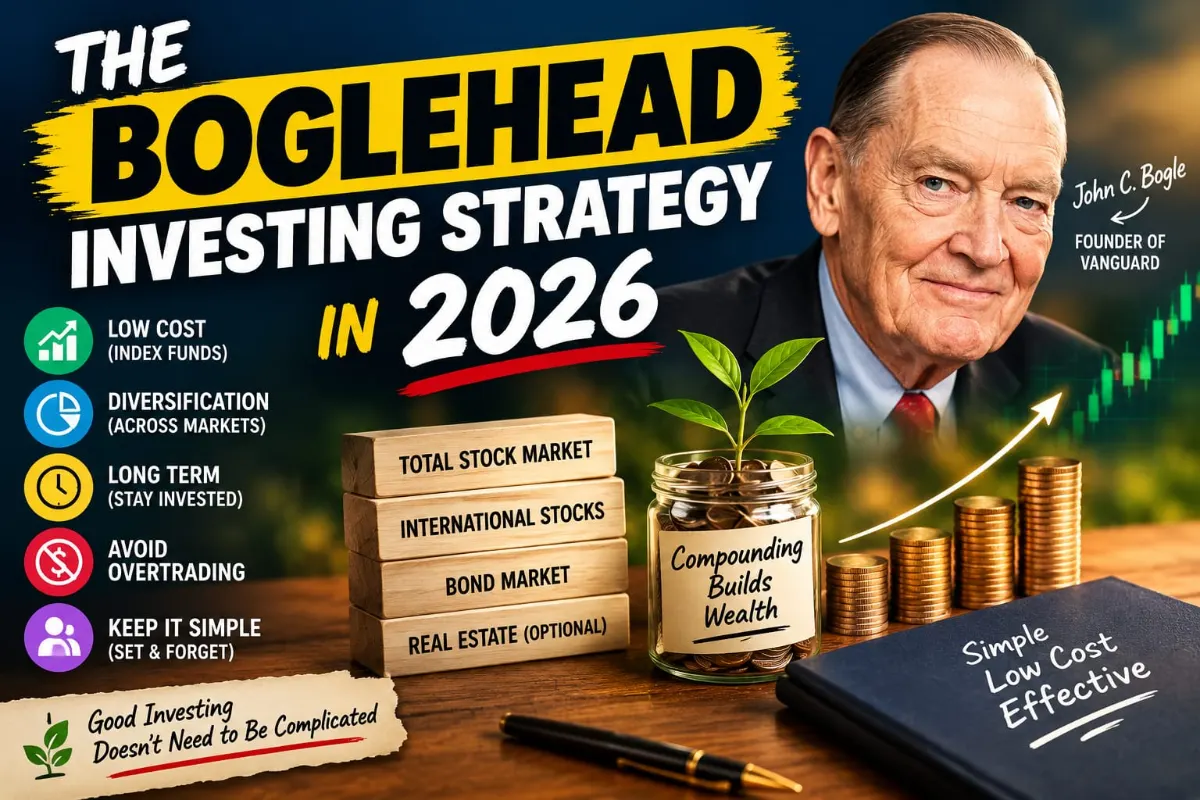
# The Boglehead Investing Strategy in 2026: The Complete Guide to Building Extended Wealth Including Simple Index Investing
Investing does not have to be complicated to be effective. The Boglehead approach is built around a simple idea: own a broadly diversified collection of low-cost index funds, contribute consistently, and give your investments time to grow.
Named after Vanguard founder John C. Bogle, the strategy avoids stock picking, market timing, and constantly chasing the latest “hot” investment. Instead, it focuses on the things an investor can control: saving rate, diversification, costs, taxes, and behavior.
This guide explains how the Boglehead investing strategy works and how to build a simple portfolio that fits your goals.
What Is the Boglehead Investing Strategy?
The Boglehead philosophy is a long-term, low-maintenance approach to investing. Rather than trying to identify the next winning stock or predict where markets will move next, Boglehead investors buy diversified funds designed to track broad market indexes.
An index fund is a mutual fund or ETF that seeks to follow the performance of a specific market index. A total-market stock fund, for example, can provide ownership in hundreds or thousands of companies through one investment. The U.S. Securities and Exchange Commission explains how index funds work and the risks investors should understand.
The goal is not to beat the market. It is to capture a broad share of market returns while keeping costs, complexity, and emotional mistakes under control.
The Core Principles of Boglehead Investing
1. Start with a clear financial goal
Before choosing a fund, decide what the money is for. Retirement, a future home purchase, education, and financial independence all have different timelines.
A portfolio intended for a goal decades away may be able to withstand more short-term volatility than money needed within the next few years. Your investment timeline and comfort with risk should shape your mix of stocks, bonds, and cash—not a headline or a social-media prediction.
2. Own the market through broad diversification
Diversification means spreading money across many investments instead of depending on one company, sector, country, or asset class. Broad index funds can make this much easier than building a portfolio one stock at a time.
For many investors, a simple portfolio includes:
- A U.S. total stock-market index fund
- An international stock-market index fund
- A broad bond-market index fund
Together, these funds can offer exposure to thousands of companies and a range of fixed-income investments. Diversification cannot prevent losses when markets fall, but it can reduce the damage caused by concentrating too much money in one area. Investor.gov offers a useful overview of asset allocation and diversification.
3. Keep investment costs low
Fees are one of the few parts of investing you can directly control. Every dollar paid in fund expenses, trading costs, advisory fees, or unnecessary commissions is a dollar that is no longer compounding for your future.
Index funds often have lower operating costs than actively managed funds because they are designed to track an index rather than employ a team to select securities. That does not mean every index fund is automatically cheap, so always check the expense ratio and any account-level fees before investing.
Small annual charges may appear harmless, but they can have a meaningful effect over long periods because they reduce the money left in the portfolio to earn future returns. The SEC’s investor guidance explains why fees and expenses matter over time.
4. Invest regularly
The Boglehead strategy is powered by consistency. Set up automatic contributions from each paycheck or each month, then continue buying through good markets and bad ones.
This habit helps remove emotion from investing. Instead of wondering whether today is the “perfect” moment to invest, you follow a repeatable plan. When prices are lower, regular contributions buy more shares; when prices are higher, they buy fewer. Over time, the focus stays on building ownership rather than forecasting short-term prices.
5. Match your portfolio to your risk tolerance
There is no universal best allocation. A younger investor saving for retirement may choose a portfolio with a larger share of stocks, while someone nearing a major spending goal may prefer more bonds or cash to reduce volatility.
Ask yourself three questions:
- When will I need this money?
- How much temporary decline could I realistically tolerate without selling?
- Is my emergency fund and high-interest debt situation strong enough to support long-term investing?
The best allocation is one you can maintain when markets are uncomfortable—not merely one that looks aggressive during a strong market.
6. Rebalance occasionally, not constantly
Over time, market movements can change your portfolio’s allocation. For example, a portfolio that begins with 70% stocks and 30% bonds may become much more stock-heavy after a long stock-market rally.
Rebalancing means bringing the portfolio back toward its original target. This can be done by directing new contributions to underweighted assets, or by selling and buying where appropriate. Many long-term investors review their allocations annually or rebalance only after a meaningful drift.
The point is to manage risk, not to trade frequently.
7. Stay the course
The hardest part of investing is often behavioral. Investors may be tempted to sell after a market decline, chase last year’s winning investment, or make dramatic changes in response to alarming news.
A Boglehead plan is designed to make those decisions less likely. By setting an allocation in advance and automating contributions, you create a system that does not depend on daily confidence or market predictions.
Markets will rise and fall. A diversified portfolio will still experience losses at times. Long-term success depends less on avoiding every decline and more on maintaining a reasonable plan through them.
How to Build a Simple Boglehead Portfolio
A simple portfolio does not mean a careless one. It means every investment has a clear purpose.
The one-fund approach
Some investors prefer a single target-date retirement fund or a balanced fund. These options generally hold a mix of stocks and bonds and may rebalance automatically over time.
A target-date fund can be a practical choice for someone who wants diversification with minimal maintenance. However, fund allocations, fees, and the path toward a more conservative portfolio vary, so review the prospectus before choosing one. Investor.gov notes that target-date funds are designed to adjust their investment mix over time, but their approaches differ.
The three-fund approach
The classic Boglehead portfolio uses three broad funds:
- A total U.S. stock-market index fund
- A total international stock-market index fund
- A total U.S. bond-market index fund
This structure is popular because it is diversified, transparent, and easy to manage. You can choose the percentage assigned to each category based on your investment timeline and risk tolerance.
The two-fund or customized approach
Some investors use only a total stock-market fund and a bond fund. Others hold a globally diversified stock fund plus a bond fund. The exact number of funds matters less than whether the portfolio is diversified, low-cost, aligned with your goals, and simple enough to maintain.
More holdings do not automatically mean better diversification. Several funds can overlap heavily, leaving an investor with more complexity but little additional benefit.
Mutual Funds vs. ETFs
Both mutual funds and exchange-traded funds can be useful tools for a Boglehead portfolio.
Mutual funds are typically bought or sold once per business day at their net asset value. ETFs trade throughout the day like stocks. Depending on the provider and account, either type may offer low costs, broad diversification, and automatic investing options.
When comparing choices, look beyond the label. Review:
- The index the fund tracks
- Expense ratio
- Holdings and degree of diversification
- Minimum investment requirement
- Trading costs or bid-ask spreads
- Tax considerations for the type of account you use
Read the fund’s prospectus and shareholder materials before investing. The SEC recommends reviewing fund disclosures to understand objectives, risks, holdings, and fees.
Use the Right Accounts First
For U.S. investors, the account can matter as much as the fund. A workplace retirement plan, IRA, HSA, taxable brokerage account, or education account may each have different contribution rules and tax treatment.
A sensible order often starts with capturing any available employer retirement-plan match, then considering other tax-advantaged accounts that fit your circumstances. Contribution limits, withdrawal rules, and tax benefits can change, so confirm current rules with the IRS, your plan provider, or a qualified tax professional.
The Boglehead principle still applies across account types: keep investments diversified, costs low, and decisions aligned with the purpose of the account.
Common Mistakes to Avoid
Chasing performance
Last year’s top-performing fund may not remain a top performer. Choosing investments based only on recent returns can lead to buying after prices have already risen and selling after they fall.
Owning overlapping funds
A U.S. large-cap index fund, an S&P 500 fund, and a total U.S. stock-market fund may hold many of the same companies. Review holdings before adding funds simply for the appearance of diversification.
Trying to time the market
Waiting for the “right” entry point can leave money uninvested while you search for certainty. A regular investment schedule is often easier to follow than trying to predict short-term market moves.
Ignoring fees and taxes
A portfolio should be reviewed for fund expenses, account charges, unnecessary trading, and the tax impact of buying or selling in taxable accounts.
Taking more risk than you can handle
An aggressive portfolio only works if you can stay invested through a major decline. If a market drop would cause you to abandon the plan, a more balanced allocation may be a better fit.
A Simple Boglehead Action Plan
- Build an emergency fund and address high-interest debt.
- Define your goal and timeline.
- Choose an asset allocation you can maintain.
- Select one, two, or three diversified, low-cost index funds.
- Use tax-advantaged accounts where appropriate.
- Automate contributions.
- Review your allocation periodically and rebalance when necessary.
- Ignore daily market noise and stay focused on the long term.
Final Thoughts
The Boglehead investing strategy is not designed to be exciting. That is part of its strength.
By owning a broad slice of the market, limiting costs, investing consistently, and avoiding unnecessary changes, you can create a portfolio built for long-term participation rather than short-term prediction. The strategy will not eliminate risk or guarantee returns, but it can give you a clear, disciplined framework for building wealth over time.
This article is for educational purposes only and is not personalized investment, tax, or legal advice. All investing involves risk, including the possible loss of principal. Consider your financial goals, risk tolerance, and tax situation, and consult a qualified professional when appropriate.